

If you have been asked for a media buying proposal template, build a narrative business case with the media plan embedded as a table or appendix, and make every section carry its own evidence. Most templates in circulation are either a spreadsheet of placements or a document of headers with nothing behind them. Neither survives a procurement review, and neither helps a CFO decide. This guide gives you a field-by-field structure, then spends most of its length on the four fields that decide approval: how fees sit beside working media, how projected results will be tested rather than asserted, where scope ends, and how the same document adapts to an internal budget pitch. Allocation rules such as 70-20-10 describe what peers do rather than what your marginal dollar returns, as GPI's guidance on allocating a marketing budget argues, and a proposal has to reason better than that.
Most proposal templates are optimised to look finished rather than to be checked. Our position is that a media buying proposal should be written as though the buyer will audit it in ninety days, because a good buyer will. Every projected number should carry its source, the date and scope of the data behind it, and the test that will confirm or retire it. Every fee should sit on its own line next to working media. The measurement section should name the one business decision the campaign exists to answer, because attribution dashboards will report something regardless, so the proposal must commit in advance to how incremental impact will be read. An honest proposal gives up some theatre and earns a renewal.
Proposal or Media Plan? What a Media Buying Proposal Template Actually Contains
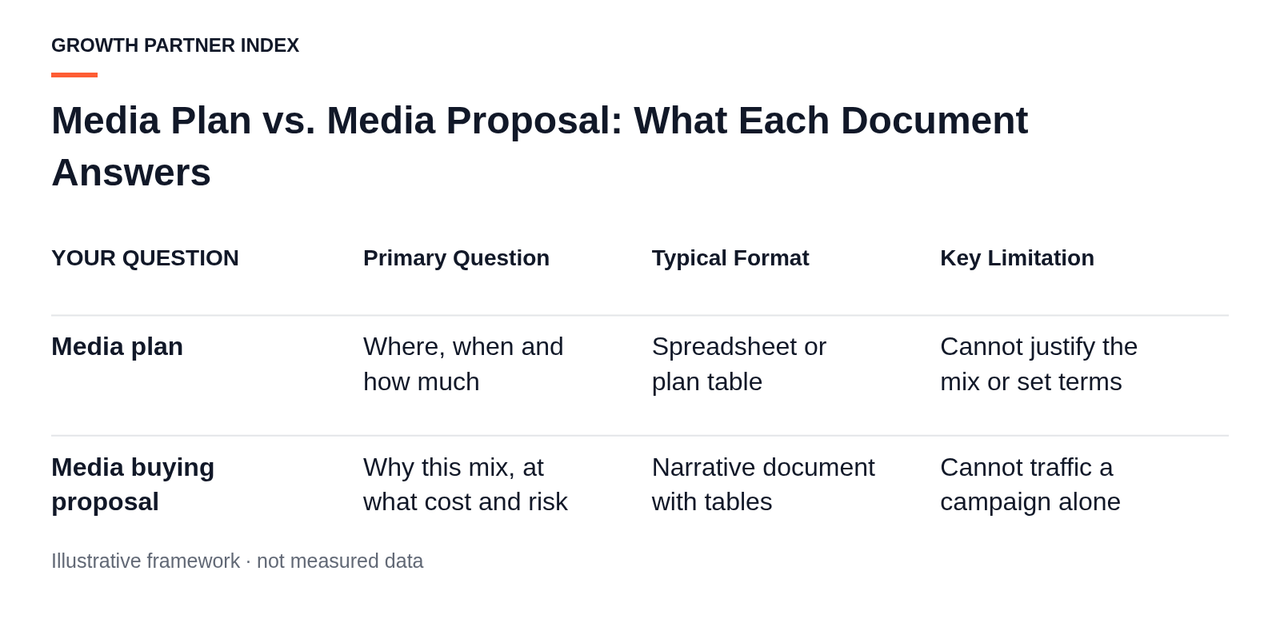
The spreadsheet answers where and when; the proposal answers why and at what risk
A media plan is the grid: channels, placements, flighting dates, budget by line, expected reach and frequency. GaleForce Digital describes its template as a roadmap for where, when and how ads will be placed, which is a clean definition of a plan. A proposal is the business case wrapped around that grid. It states what the client wants to happen, why this mix should cause it, what it costs in fees and media, how the result will be verified and what sits outside scope. Qwilr's template opens with client objectives and audience insight, which is proposal content rather than plan content.
| Artifact | Primary question it answers | Typical format | Who reads it | What it cannot do alone |
|---|---|---|---|---|
| Media plan | Where, when and how much | Spreadsheet or plan table | Media team, trafficking, finance | Justify the mix or set fee and scope terms |
| Media buying proposal | Why this mix, at what cost and risk, measured how | Narrative document with embedded tables | Marketing lead, procurement, CFO | Traffic a campaign or replace the SOW |
Definitions draw on the GaleForce Digital and Qwilr pages cited above.
How the plan nests inside the proposal
The plan is a table or appendix inside the proposal, never a substitute for it. Search results for the primary keyword mix the two: HubSpot and Medialister rank spreadsheet downloads, while Qwilr and PandaDoc rank narrative documents. A buyer who receives only the spreadsheet has no argument to approve. A buyer who receives only prose cannot check the numbers. Put the objectives-to-channels argument in the body and the line-item grid directly beneath it, so each budget line can be traced back to a stated reason.
What the top-ranking templates leave out
Across the ranking pages, three things are consistently absent: a measurement design that says how results will be read, any framing of the agency pricing model, and a stated boundary on who produces creative. The next section gives the full field list. The three sections after it fill those gaps, and a later section adapts the whole structure for an in-house pitch to leadership.
The Media Buying Proposal Template, Section by Section
Copy the field table below into a working document and mark each field as mandatory, conditional or optional for your typical engagement size. GaleForce Digital's plan components (objectives, audience, channels, budget, schedule, creative, metrics and contingency) map onto this structure, but the proposal adds the situation analysis, the assumptions register and the acceptance terms that a plan alone omits.
Executive summary, situation analysis and objectives
Open with the client's stated objective in their own words, the recommended channel mix in one sentence, and the single measurement decision the campaign will answer. A proposal is a persuasive document and, like any research proposal, it earns credibility by stating the problem, the method and the expected contribution before asking for resources. The situation analysis follows: current spend, current results, what the client has already tried, and the constraint that makes this brief necessary. Keep it to what changes the recommendation. Objectives then turn the summary into measurable targets. Write them as a business outcome (qualified leads, incremental revenue, store visits) with a number, a period and a baseline, and keep media metrics out of the objectives. Impressions and CTR belong in the plan as delivery indicators, not in the objectives as goals.
Audience, channel strategy and the embedded media plan
The audience section should describe people by the signals a channel can act on: demographics, behaviours, intent and the data the client holds. Qwilr's template asks for audience demographics, interests and behaviours, which is the right instinct, but the field only becomes useful when each audience attribute is paired with the channel that reaches it and the data source that identifies it. A first-party CRM segment implies retargeting and lookalike expansion; a broad demographic implies reach media; a search-intent audience implies biddable search. Channel strategy then explains the role of each channel in the funnel and why this mix rather than the obvious alternatives. Strategy guides such as DotIt's treat channel selection as a function of campaign goals, and that is the logic the proposal should show, not just the result.
The embedded media plan sits directly under the strategy. Give it these columns: channel, buy type (direct publisher, private marketplace, open exchange, biddable auction), flighting window, budget share, primary audience, expected funnel role, and the delivery indicator you will monitor. Buy type matters because it changes how price is set and how quickly budget can move. Direct and PMP deals lock inventory and rates; biddable media floats. A buyer reading the table should be able to see which lines can be paused in a week and which are committed.
Budget, measurement, scope, timeline, team and acceptance
The budget field presents working media separately from fees, technology and production; the next section covers how to structure and price it. The measurement field names the primary KPI, the decision it drives, the baseline and the verification design; the section after budget covers that in detail. Scope and contingency state creative ownership, reallocation triggers and approval rights, covered in the section after measurement. The remaining fields are simpler but still need discipline.
Timeline shows the launch date, flighting phases, creative delivery dates and the dates on which results will be read, so the buyer knows when a decision is due. Team lists named roles, hours or coverage per role and the escalation path. Reporting cadence states what is delivered weekly, monthly and at each read date, and what format. The assumptions register lists every input the projections depend on (platform costs, creative volume, landing page performance, seasonality) so that when one changes, both parties know which forecast it affects. The acceptance block records the signatory, the accepted terms that will move into the SOW, and the validity period of the proposal. Buyer-side guides such as DesignRush's media buying RFP template show what procurement teams ask for; mirror their questions so your proposal answers the RFP rather than restating your services.
| Template field | Question it must answer | Evidence or input to attach | Common failure mode |
|---|---|---|---|
| Executive summary | What is being recommended, at what cost, measured how | Client objective in their words, one-line mix, the decision to be answered | Reads as an agency biography |
| Situation analysis | Why is this brief necessary now | Current spend and results, prior tests, constraints | Generic market commentary with no client data |
| Objectives | What business outcome, by how much, by when | Baseline figures, target, period | Media metrics presented as goals |
| Audience | Who, identified by which signals, reached where | Segment definitions, data sources, size estimates | Persona names without actionable attributes |
| Channel strategy | Why this mix and not the alternatives | Funnel role per channel, rejected options and reasons | List of channels with no argument |
| Embedded media plan | Where, when, how much, on what buy type | Plan table with flighting and budget share | Spreadsheet attached with no link to objectives |
| Budget and fees | What reaches the audience and what pays the agency | Separate lines for media, fees, tech, production, reserve | Blended figure that hides the fee |
| Measurement | Which decision the result settles and how it is verified | KPI, baseline, holdout or geo design, read dates | ROAS projection with no test |
| Scope and contingency | Who does what, and what triggers change | Creative ownership, thresholds, approval rights | Silence on creative and reallocation |
| Timeline | When things launch and when decisions are due | Phase dates, creative deadlines, read dates | Launch date only |
| Team and reporting | Who is accountable and what they deliver | Named roles, coverage, report formats and cadence | Unnamed team, unspecified reports |
| Assumptions register | What the forecast depends on | Listed inputs with sources | Assumptions buried in footnotes |
| Acceptance | Who signs, what carries into the SOW, for how long | Signature block, validity period, carried terms | No validity date, no SOW handoff |
Field definitions synthesise the GaleForce Digital, Qwilr, Scribbr and DesignRush pages cited in this section. Mark the budget, measurement and scope fields mandatory for any engagement; they are the ones that fail under scrutiny.
Budget and Fees: Presenting Working Media and Agency Pricing Side by Side
Rebuild your budget table with fee lines separated from working media, and add one sentence of rationale beside every allocation percentage.
Separating working media from fees, tech and production
A buyer wants to know how much of the total reaches an audience. Present the budget as distinct lines rather than a single campaign figure. A hypothetical structure, with invented figures purely to show the layout, might read: working media by channel as the largest block; platform, data and ad-serving fees as a second block; creative production and adaptation as a third; agency management fee as a fourth; and a testing reserve as a fifth, held back and released against pre-agreed tests. Guides to budgeting media buying costs cover the categories that swell beyond media itself; the proposal's job is to make each visible. The ANA's media buying contract template exists partly because advertisers have pushed for transparency on how agencies are paid, and a proposal that anticipates those contract terms shortens the negotiation that follows.
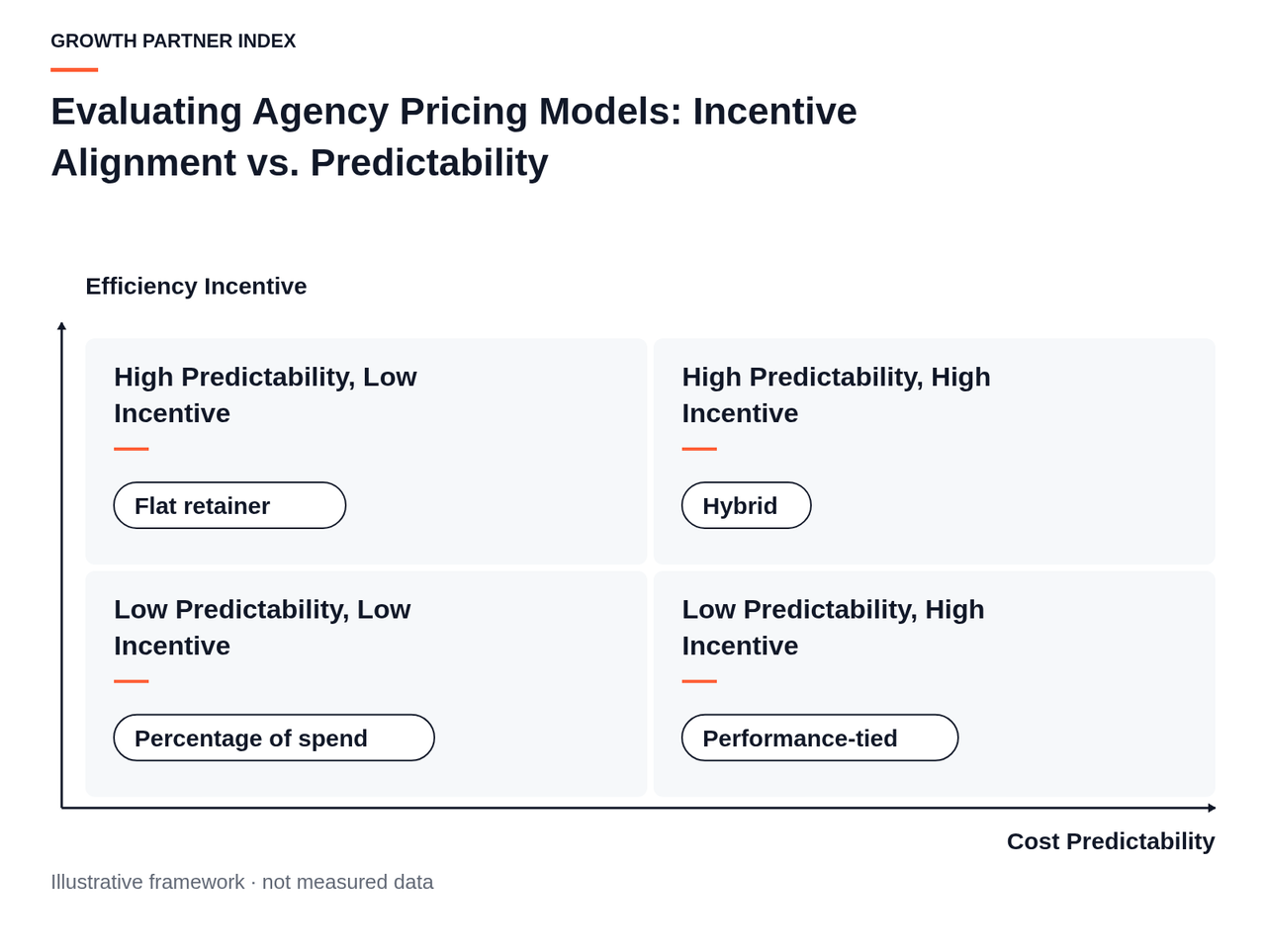
Percentage of spend, flat retainer, hybrid and performance-tied fees
| Pricing model | How the fee is calculated | Incentive it creates | Best fit | What to disclose in the proposal |
|---|---|---|---|---|
| Percentage of spend | Fixed share of working media | Rewards spending more, not spending better | Large, stable budgets where scale drives workload | The percentage, the base it applies to, and a cap or floor |
| Flat retainer | Agreed monthly fee for defined scope | Rewards efficiency; risks under-servicing if scope grows | Steady budgets with predictable scope | Hours or deliverables covered and the change process |
| Hybrid | Retainer plus a smaller percentage or bonus | Balances stability and scale | Growing budgets with uncertain volume | Both components and how each is reviewed |
| Performance-tied | Fee moves with an agreed outcome metric | Rewards the metric, which may not be the business outcome | Clients with reliable measurement and agreed attribution rules | The metric, its measurement method and the verification design |
The models and incentives described here are standard industry structures; the disclosure column reflects the transparency concerns behind the ANA contract template cited above.
Why allocation percentages need a stated rationale
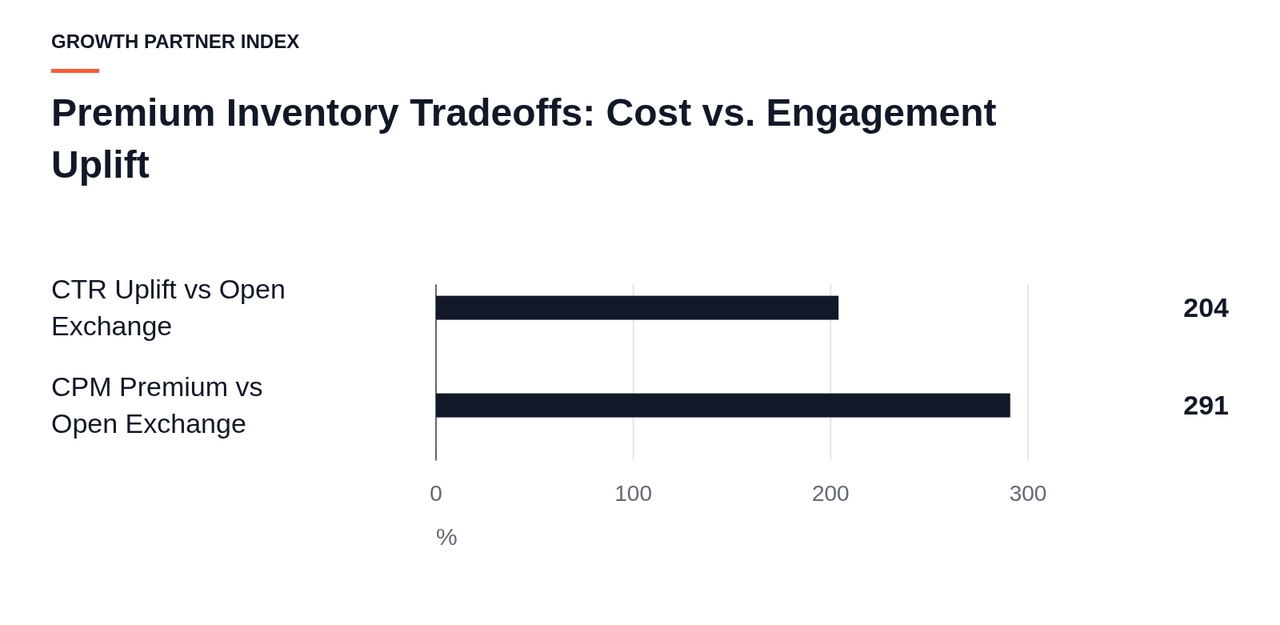
Every percentage in the plan table needs a sentence of reasoning. Two failures are common. The first is presenting a heuristic such as 70-20-10 or percent of revenue as the logic; those rules summarise peer behaviour rather than the marginal return of the client's channels, a point GPI develops in its guidance on whether to deepen or diversify paid media budgets. The second is recommending premium inventory without stating the cost side. Focus Digital's report on its 2025 client campaigns, published in January 2026, found private marketplace inventory delivered a 204% higher CTR at a 291% CPM premium compared with open exchange. A proposal recommending PMP buys should state both numbers, note that they come from one agency's campaigns rather than a market benchmark, and explain why the tradeoff suits this client. The testing reserve line then closes the argument: state its size, the tests it funds and the read dates at which it is released or returned.
Proving Projected Results: Measurement and Incrementality Inside the Proposal
Replace every ROAS or CPA projection in your draft with an assumption line that names its source, the date and scope of the data, and the test that will verify it.
State the business decision the measurement will answer
Measurement in a proposal commits to answering one decision the client faces: whether to scale this channel, whether to keep this agency, whether the new product line can be acquired profitably. Write the measurement section as a short process:
- Name the primary KPI and the decision it drives.
- State the baseline and where the baseline figure comes from.
- Choose the verification design: holdout, geo test, platform lift study or a modelled read.
- Fix the read dates and who attends the readout.
- Define success, the early-warning threshold and what happens at each outcome.
Last-click ROAS projections without a test invite scepticism because the dashboard will report a number whatever the media did. A pre-agreed incrementality design removes the argument before it starts, which is why GPI's budgeting guidance, cited in the introduction, treats marginal return as the allocation question rather than any percentage rule.
Benchmarks as inputs with provenance, not promises
Third-party benchmarks are useful scenario inputs and poor promises. The same Focus Digital 2025 report cited in the budget section put first-party data combined with lookalike modelling at 0.73% CTR, 142% above contextual targeting. Quoted in a proposal, that figure needs three labels: the source, the year and scope (one agency's 2025 client campaigns), and the test that will check whether the client's own campaign lands anywhere near it. The same discipline applies to industry compilations such as LocaliQ's search advertising benchmarks; cite the edition and industry cut, and treat the figure as a starting assumption. Scenario tools such as HubSpot's ROAS calculator can show how an outcome moves with CPC and conversion rate, which is exactly how a projection should be presented: as a function of stated inputs, each of which can be wrong.
| Projection type | Required provenance | Verification method | Read timing |
|---|---|---|---|
| CTR or CPM by channel | Named report, year, dataset scope | Compare delivered figures after the first flight | End of first flight |
| Conversion rate | Client historical data or labelled benchmark | Holdout or geo test on the conversion event | First read date in the timeline |
| ROAS or CPA | Inputs above plus attribution rule | Incremental lift versus control, not platform-reported | Agreed read date, then quarterly |
| Reach and frequency | Planning tool output with date | Delivered reach from ad server or panel | Weekly during flight |
Provenance requirements follow the labelling rule applied to the Focus Digital and LocaliQ sources cited above.
Holdouts, geo tests and the testing reserve
Where the budget allows, name a geo holdout or audience holdout in the proposal and fund it from the testing reserve. Where it does not, commit to the smallest honest design: a platform lift study, a pre and post read against a matched period, or a staged rollout by region. State the limitation of whichever design you pick. Then set the reporting cadence so early-warning thresholds are checked weekly and the decision KPI is read only at the agreed dates, which stops both parties from over-reacting to noise.
For a sense of how documented claims are presented across listed media buying agencies, browse the GPI category before finalizing your own proposal's evidence sections.
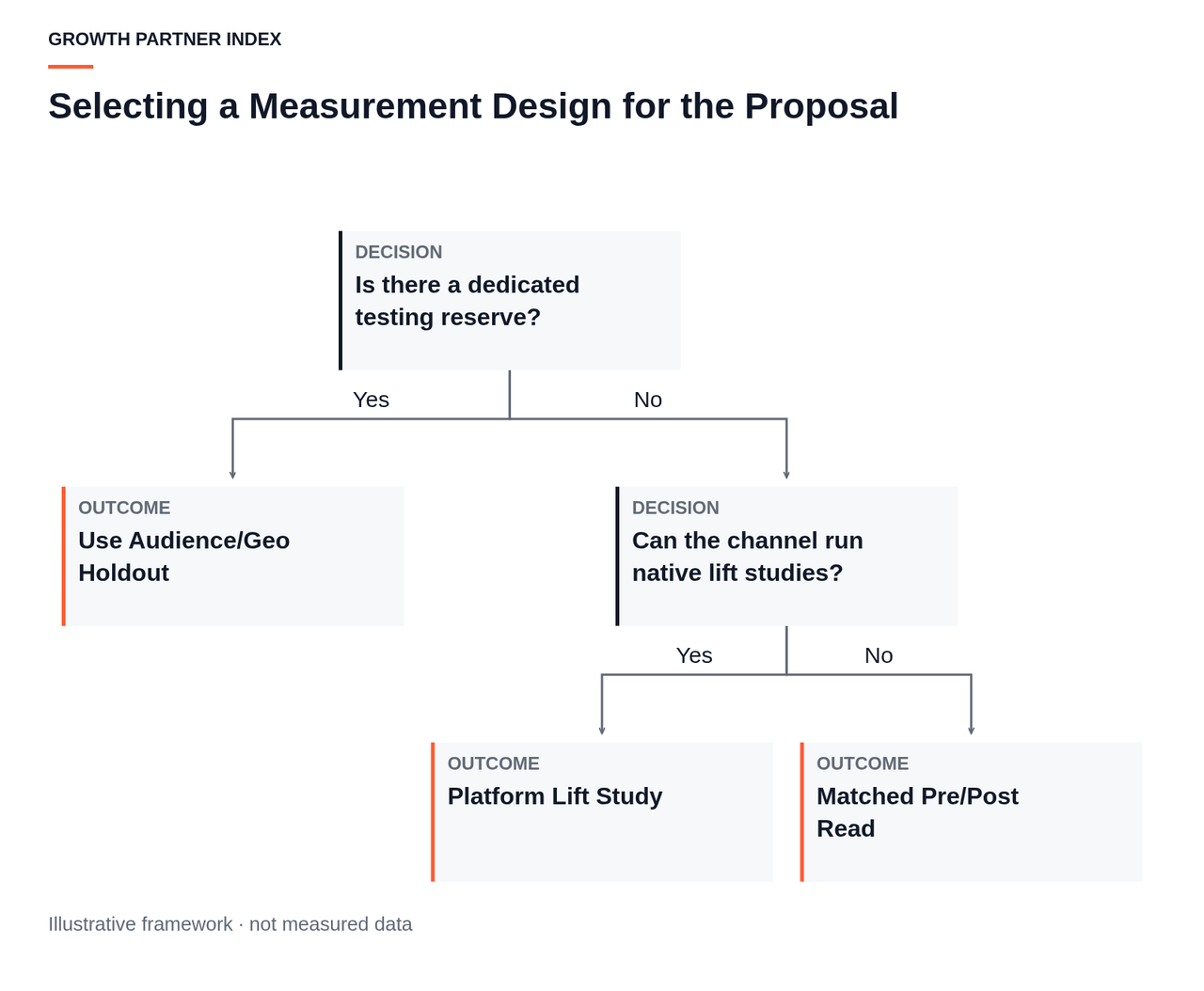
Scope Boundaries and Contingencies: Creative, Platform Changes and Cost Spikes
Add a one-page scope and contingency annex naming creative ownership, reallocation triggers and approval rights before the proposal goes out. GaleForce Digital lists contingency among the required plan components, as noted earlier; the proposal turns that heading into specific clauses.
Who produces creative and at what cadence
Creative ownership changes media pacing, so it cannot be left implicit. State one of three arrangements:
- Client-supplied assets, with a turnaround SLA for delivery and approvals and a statement of what happens to pacing when assets arrive late.
- Agency-produced performance creative, with a refresh cadence, a volume per channel per month and the production line in the budget that pays for it.
- Hybrid, with brand assets from the client and adaptations or variants from the agency, and a clear owner for each.
Then say how creative velocity affects the plan. Biddable social and programmatic lines fatigue faster than a direct publisher placement, so a low refresh cadence should show up as a more conservative budget share or a stated risk in the assumptions register.
Reallocation and pause triggers
Define in advance what allows the agency to move money without a new approval, and what requires one. Typical triggers include a CPA or CPM breach sustained over an agreed window, a platform policy change that blocks a format, inventory that fails to deliver against a direct commitment, and a creative asset withdrawn by the client. For each trigger, state the permitted action (pause, shift within channel, shift across channels up to a cap) and who approves anything beyond it. Optimisation tactics are widely documented in strategy guides such as DotIt's, cited earlier in the template walkthrough, but the proposal decides who is authorised to apply them and how fast.
Traditional and digital buys in one modular template
Keep the channel module identical whether the line is a regional radio buy, a PMP deal or a biddable social campaign. With buy type as a column, the same plan table records rate basis, cancellation terms and reallocation flexibility for each line, and the assumptions register lists what each depends on. Direct buys carry commitment risk; biddable buys carry price volatility. Naming both in one annex is what lets these clauses pass into the SOW unchanged and protects both parties from scope creep.
Adapting the Template for an Internal Media Budget Pitch
Rewrite your executive summary as a single decision request paired with the test that will resolve it. The core template holds; the audience and stakes change.
Reframe fees as resourcing and tooling
Where an agency proposal separates management fees from working media, an internal pitch separates headcount, contractor time and platform or measurement tooling from media itself. Leadership needs to see what the team costs to run the plan, not just what the media costs, and needs to see the two as distinct lines that move independently. Production capacity belongs here too, since a plan that outruns the creative team's output fails for reasons unrelated to media.
| Agency proposal field | Internal pitch equivalent | What leadership needs to see |
|---|---|---|
| Client objectives | Company targets for the period | The line in the annual plan this spend serves |
| Agency fees | Headcount, contractors and tools | Fully loaded cost of running the plan, separate from media |
| Measurement design | Decision the finance team will make from the read | The test, the read date and what each outcome triggers |
| Scope and contingency | Team capacity and reallocation authority | Who can move budget and up to what limit |
| Acceptance block | Budget sign-off | The approval requested and its validity |
The mapping follows the field structure defined earlier in this article.
Present allocation as tested marginal return, not benchmarks
Internal pitches attract percent-of-revenue pushback: a peer spends less, so why should we spend more. The defence is the same incrementality framing used with clients. A hypothetical in-house lead asked to justify moving a fifth of the budget into connected TV should present a geo holdout design and the date on which the incremental read arrives, rather than citing a peer allocation heuristic. Scenario tools can show leadership how the outcome moves if the input assumptions miss, which is more persuasive than a single projected figure.
Give leadership a decision, not a document
Executives approve decisions, not documents, so lead with a one-page summary that states the decision requested, the cost, the test and the read date, and attach the full proposal as an appendix. If the one page cannot state what leadership will learn and when, the proposal is not ready.
Standardizing the Proposal Workflow: Versions, E-Signature and CRM Handoff
Create a pre-send checklist from the mandatory fields and attach it to your template's version notes.
Lock the mandatory fields and version the template
Keep one master template with objectives, measurement, scope and fees locked as mandatory, and treat each channel as an editable module that can be added or removed without touching the locked fields. Qwilr's template pairs pre-written service sections with an acceptance block, and the same structure works in any document tool as long as the mandatory fields cannot be quietly deleted under deadline pressure. Number versions and record what changed, so a proposal sent last quarter can be compared with the current standard.
E-signature, acceptance and the SOW handoff
Proposal platforms such as PandaDoc distribute templates designed to be completed and accepted inside the same document. Whatever tool you use, the accepted terms (fees, scope, triggers, measurement design, validity period) should move into the SOW and the CRM record as structured fields rather than being retyped, because retyping is where fee percentages and trigger thresholds drift.
What proposal analytics can and cannot tell you
View and dwell analytics show that a buyer opened the document and which pages held attention. They do not show intent, objections or who else was in the room. Treat them as a prompt for a follow-up conversation, not a forecast. Before sending, run a short review:
- Every projection names its source, date, scope and verification test.
- Every fee sits on its own line beside working media.
- Every scope boundary and reallocation trigger is explicit.
- The acceptance block carries a validity date and the terms that pass into the SOW.
How GPI Reads a Media Buying Proposal: Evaluating the Result as a Buyer Would
Score your draft against the rubric below and fix any field that makes a claim without evidence, methodology or limitation.
Evidence, methodology and limitations for every claim
GPI assesses agencies on documented evidence rather than asserted results, and its Growth Partner Confidence Score methodology is built around what a claim can be checked against. Read your proposal the same way a listed agency's profile is read:
- Are objectives mapped to specific channels with a stated reason for each?
- Are fees, technology, production and the testing reserve visible as separate lines from working media?
- Does every projected number carry its source, its date and scope, and the test that will verify it?
- Is creative ownership explicit, and are reallocation triggers and approval rights written down?
- Does the acceptance block carry terms that can pass into the SOW without interpretation?
Agency profiles in the index, such as Avalaunch Media's listing, present services and location as documented facts rather than results claims. That restraint is the register a proposal should adopt: state what you will do and how it will be checked, and let the measurement design carry the promise.
Signals that the template is working
The first signal is that procurement questions get shorter, because the fee and scope answers are already in the document. The second is that the first quarterly review compares delivered results with the assumptions register instead of relitigating what was promised. An honest proposal reads as less impressive than one built on promise-heavy projections, and that is the tradeoff. It also survives the ninety-day audit, which is where renewals are decided.
FAQ
Should a media buying proposal quote third-party CTR or CPM benchmarks, and how should they be labelled?
Yes, as scenario inputs. Label each with the publisher, the year and the dataset scope, and pair it with the test that will check the client's own result. A single-agency figure such as Focus Digital's 2025 client data must be described as exactly that, never as a market average.
How do we present a percentage-of-spend fee without appearing incentivised to overspend?
Disclose the percentage and its base, add a cap or a step-down above a spend threshold, and tie the testing reserve release to incremental reads rather than to spend. Showing that budget moves only when a test justifies it is the strongest answer to the incentive concern.
What is the minimum measurement commitment a proposal should make when the budget is too small for a geo holdout?
Name the decision the campaign answers, fix the baseline, and commit to the smallest honest design available: a platform lift study, a staged rollout or a matched pre and post period. State its limitation in the assumptions register so nobody mistakes the read for a causal proof.
Who owns creative production in a media buying proposal, and how does that change pacing assumptions?
The proposal must say. Client-supplied assets need turnaround SLAs; agency-produced creative needs a refresh cadence and a production budget line. Slower creative velocity should translate into more conservative budget shares on fatigue-prone biddable channels and a listed pacing risk.
Can one template cover direct TV or radio buys and biddable digital media without separate documents?
Yes, if buy type is a column in the plan table and each line records rate basis, cancellation terms and reallocation flexibility. Direct buys carry commitment risk, biddable buys carry price volatility, and the assumptions register records both.
What triggers should allow the agency to reallocate budget without a new approval?
Pre-agreed thresholds: a CPA or CPM breach sustained over a stated window, a platform policy change blocking a format, or undelivered direct inventory. Define the permitted action and a cap for cross-channel shifts; anything beyond the cap needs named approval.
How much of the media plan spreadsheet should appear in the proposal body versus an appendix?
The summary plan table (channel, buy type, flighting, budget share, funnel role) belongs in the body directly under the channel strategy. Full placement-level detail, in the style of downloadable planning sheets such as Nanoo Marketing's template, belongs in an appendix the media team and finance can work from.
