

An agency pitch looks like a procurement exercise and behaves like a capital project. The 2023 ANA/4A's Cost of the Pitch study estimated the client-side cost of a review without the incumbent at $408,500, before counting the campaigns that slip while senior people sit in evaluation rooms. That estimate comes from self-reported member survey data, so treat it as an order of magnitude rather than a quote for your organisation. The point stands either way: a review is a budget line that competes with media spend and headcount. This guide is for CMOs, marketing directors and procurement leads deciding whether to run a pitch at all and, if they do, how to structure, staff, sequence and evaluate it so the money goes to the stages that change the decision rather than to presentation theatre.
GPI reads a pitch the way it reads any measurement exercise. It earns its cost only when it answers a decision you cannot answer more cheaply. Most reviews are launched to resolve doubt, and doubt about an agency is often a measurement problem in disguise. So the first question is what evidence about the current partner you already hold and what a review would add to it. When a review is warranted, budget should flow to the parts that test claims against evidence, method and stated limitations: the baseline, the contract and data terms, the named staffing and the scorecard. The polished final presentation is the most expensive and least informative thing a pitch produces.
TL;DR: Running an Agency Pitch Without Wasting Budget
- A pitch is a real budget line. The 2023 ANA/4A's study put the client-side cost of a review without the incumbent at $408,500, and roughly one in three marketers reported disrupted daily work during incumbent reviews.
- Two in three clients kept their incumbent after their last review in the same 2023 survey, so test whether renegotiation or a scoped trial answers your question before launching a full RFP.
- Most waste originates on the client side: vague scope, internal decisions that stall after agencies were rushed, and oversized asks that agencies price into their responses.
- Put the draft contract and fee model in front early, and settle ownership of ad tech accounts and data outputs during the pitch, not after it.
- Judge AI and automation on the productivity gains passed back to you, not on demo polish.
- A published, defined process lets agencies decide where to invest their effort, which improves the field and the responses.
What an Agency Pitch Actually Costs the Brand
The client-side bill: what the ANA/4A's 2023 study measured
The one number worth carrying into an approval meeting is the ANA/4A's 2023 estimate of $408,500 in client-side cost for a pitch run without incumbent participation. The figure was built from members' own estimates of hours and fees, so it is a self-reported average across a specific respondent group rather than an audited cost record. Use it to size the problem, then build your own estimate from four cost lines that map to any organisation without inventing precision:
- Senior marketing time: the CMO, category leads and analytics staff who write the brief, attend presentations and score responses.
- Procurement and legal time: RFI and RFP administration, contract drafting and negotiation rounds.
- External fees: search consultants, auditors and benchmarking services where used.
- Opportunity cost: work that stops because the people who would do it are running the review.
Operational disruption and delayed launches
The fourth line is the one finance rarely sees. In the same 2023 study, 34% of marketers reported disruption to daily tasks and 28% reported delayed campaign or product launches during incumbent reviews. A delayed launch has a revenue shape as well as a calendar shape. It belongs in the cost estimate even if all you can do is bracket it between a low and high case.
What agencies spend, and why you end up paying for it
Agencies carry their own bill. Power Your Point cites Campaign UK research from 2023 that put the average agency cost of a pitch at over £50,000, up 26% year on year. That cost does not stay on the agency's side of the table. Agencies recover pitch spend through the fees they quote to the clients they win, and they decline reviews whose process looks expensive or unfair, which thins the field you are choosing from. Every deliverable you request beyond what the decision needs is priced somewhere, either into your future retainer or into a weaker shortlist.
The industry-level figure and how to read it
Forrester's May 2023 estimate that agency reviews cost agencies and, by extension, their clients $12.5 billion a year is a modelled figure, not a tally of invoices. It is not a benchmark for your review. Its value is as a governance argument: the process itself, not just the outcome, is where waste sits, so a marketing leader who runs a disciplined review protects budget as directly as one who negotiates a lower fee.
One cost line rarely appears in pitch guides: transition. Moving from an incumbent to a new agency means knowledge transfer, platform and account handover, and a period of parallel running during which two agencies are paid. We found no verified figure for this line, so estimate it from your own contract terms and put it into the model before the decision meeting, not after.
| Cost line | Who bears it | What the evidence says (and its date) | Lever that reduces it |
|---|---|---|---|
| Senior, procurement and legal time | Client | Included in the $408,500 client-side estimate, ANA/4A's 2023, self-reported | Precise scope and a short RFI before any RFP |
| Disruption and delayed launches | Client | 34% disruption, 28% delays in incumbent reviews, ANA/4A's 2023 | Decide whether a lighter route answers the question |
| Agency pitch spend passed back through fees | Agency, then client | Over £50,000 average per pitch, up 26% year on year, Campaign UK 2023 as cited | Proportional asks and a published process |
| Industry-level process waste | Whole market | $12.5 billion a year, Forrester 2023, modelled | Governance: fixed calendar and single decision meeting |
| Transition and parallel running | Client | No verified figure found | Plan overlap and handover before the decision |
Sources for the table: the ANA/4A's Cost of the Pitch 2023 report and its ANA summary page, Power Your Point's summary of Campaign UK research, and Forrester's Ditch the Pitch blog. All quantitative entries reflect 2023 study periods, not current-year benchmarks.
Build a one-page estimate across these five lines before approving the review. For how agency fees and testing reserves fit inside the wider plan, see GPI's guide to allocating a marketing budget using incrementality.
Decide First: Full Pitch, Scoped Trial, or Renegotiation
Why two in three reviews end with the incumbent
In the 2023 ANA/4A's survey, two in three clients reported retaining their incumbent after their most recent review. Read generously, the incumbents earned it. Read critically, a large share of six-figure reviews confirmed what the client already suspected, which means a cheaper instrument could have answered the question. The figure is self-reported member data from 2023 and describes a pattern, not fixed odds for your review. It still justifies asking, before any brief is written, what this review would tell you that you do not already know.
Triggers that justify a full competitive review
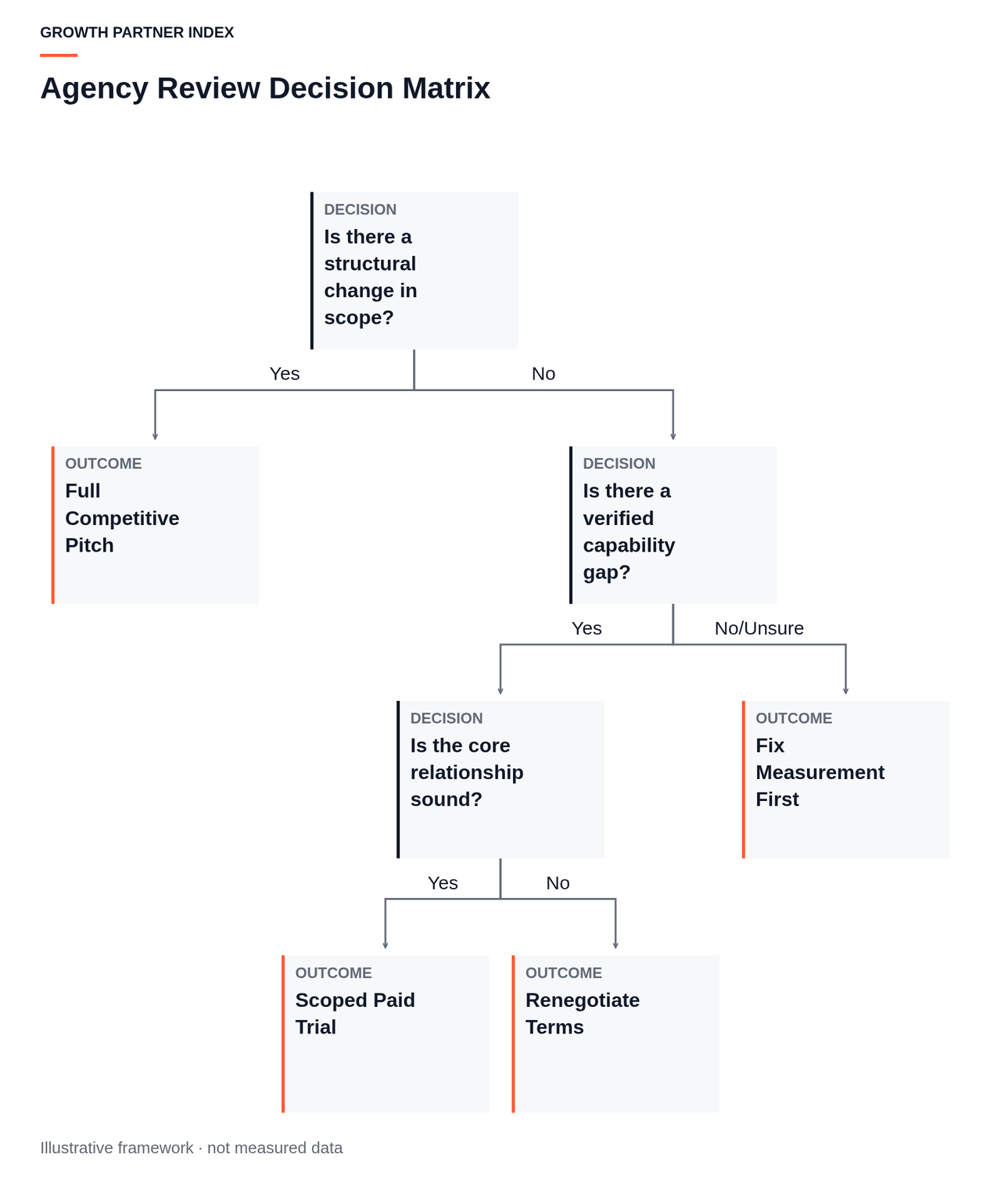
Some triggers carry the cost. A documented capability gap the incumbent cannot close. A structural change in scope, such as a new market or a shift of budget into a channel the agency does not buy. A contract expiry with no renewal rights. A performance problem supported by evidence and unresolved after a formal remediation period. Triggers that rarely justify a full review on their own: a new CMO who wants a fresh start, one weak quarter without a comparable baseline, or fatigue with the account team, which a staffing change can address in weeks.
When a project trial or renegotiation answers the question
A scoped project trial is a paid, bounded assignment given to a challenger, with success measures agreed before work starts. It tests a capability claim in live conditions without an RFP and without pulling the incumbent off core work. Renegotiation reopens the same items a pitch would test: staffing and seniority mix, fee model, data and account ownership, measurement and reporting cadence. Its advantage is that you already hold performance evidence on this partner, which no challenger can offer. Because the disruption and delay figures were reported specifically for incumbent reviews, renegotiation also carries less operational exposure.
A decision test before you spend
- Write the single business decision the review must answer in one sentence.
- Check whether existing performance evidence already answers it. If it cannot because measurement is weak, fix measurement first; a pitch will not repair a missing baseline.
- Estimate the cost using the five lines from the previous section.
- Match your situation to a route in the table and record the signal that would tell you the route was correct.
| Situation | Recommended route | Cost and disruption exposure | Signal the route was correct |
|---|---|---|---|
| Contract expiring and scope moving into channels the incumbent does not buy | Full competitive review | Highest: full client-side cost plus transition | The chosen agency delivers the new scope against the agreed baseline |
| Specific capability doubt, core relationship sound | Scoped paid trial with a challenger | Moderate: trial fee and limited internal time | Trial results answer the capability question either way |
| Performance dip with no comparable baseline | Fix measurement, then renegotiate | Low: analytics time and one negotiation cycle | A baseline exists and the dip is explained or reversed |
| Fee, staffing or data-terms dissatisfaction | Renegotiation using pitch criteria | Low to moderate | Revised contract meets the criteria a pitch would have tested |
| Leadership change with no evidence of a performance gap | Structured account review, no pitch | Lowest | Documented decision to retain or to trigger a review later |
The table reflects practitioner judgement built on the 2023 retention and disruption data from the ANA/4A's report; it is a framework, not a measured outcome table.
A hypothetical illustration: a retailer with an expiring media contract and a documented plan to move a third of spend into retail media its agency does not trade has a valid full-review trigger. A second brand with a two-quarter performance dip and no incrementality baseline should first establish what changed, then renegotiate; a pitch would ask challengers to promise improvements against a number nobody can verify.
A Six-Stage Agency Pitch Process That Protects Budget
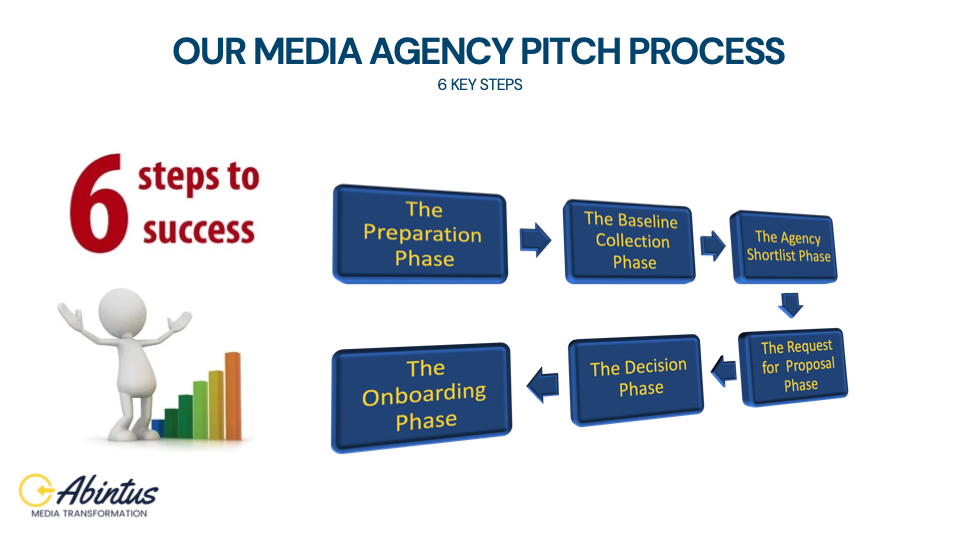
Once the decision to pitch is made, the process below sequences the work so that the expensive stages happen only after the cheap ones have narrowed the field. Each stage has a required output and a named owner. Where a stage has no owner, it has no deadline, and that is where cost accumulates.
Stage 1: Baseline and scope before any agency is contacted
Start by documenting what you are buying today. The output is a baseline pack: the current scope of work by service line, the agency team by role and time allocation, the fee model and total fees, an inventory of media, ad tech and data assets with who owns each, and the performance record with its measurement method and known gaps. The owner is the marketing lead running the review, with finance and analytics contributing. Agencies price what they can see; a vague scope forces them to price an assumption, and assumed scope is where fee proposals become incomparable. The baseline also settles whether existing evidence already answers the review's question, which is the last chance to stop cheaply.
Stage 2: Internal governance, decision rights and a timeline you can keep
Name the decision owner, the scoring panel and the escalation path, then publish a calendar with dates for every stage and a fixed decision meeting. The output is a governance sheet and a calendar signed by every panel member. The owner is the review sponsor, usually the CMO. TrinityP3 describes the failure mode plainly: marketers set punishingly short deadlines for agencies, then the process stalls on the client side. Call this decision drag. Every week of drag keeps senior people in review mode, holds the incumbent in limbo and pushes launches back, so it is a direct cost, not an inconvenience. Build the calendar backwards from the decision date and protect panel diaries before agencies are contacted.
Stage 3: Longlist and a short RFI that screens on evidence
Compile a longlist from directories, references and category knowledge, then issue an RFI that asks only for facts: relevant capability, category and market experience with named evidence, team availability and location, client conflicts, and a description of data handling and account ownership practice. The output is a scored RFI grid and a shortlist. The owner is procurement, with marketing scoring the capability questions. Exclude creative or strategic responses at this stage. They cost agencies money, they cannot be compared fairly without a brief, and they tempt panels to shortlist on style before substance has been checked.
Stage 4: Shortlist, brief and commercial terms shared upfront
Issue the brief to the shortlist with three attachments: the draft contract, the fee model you expect proposals to follow, and the data and account ownership terms. Abintus describes putting the media agency contract at the front of the process rather than the end so that terms are balanced before selection pressure sets in. The output is a brief pack with the evaluation criteria and weights, the timeline and the deliverables list. The owner is marketing for the brief and legal for the terms. Publishing the process matters for the field as well as for you: the IPA's Good Pitch guidance notes that a defined process lets agencies decide which pitches to enter and how much to invest. The technology, AI and data questions covered later in this article belong in this pack as a schedule.
Stage 5: Proportional RFP, chemistry sessions and one decision meeting
Limit the written RFP to what the decision needs, and map every deliverable to a scoring criterion. Run chemistry sessions separately from the capability and commercial evaluation: chemistry sessions test working style and senior involvement, not strategy. The output is a completed scorecard per agency, a commercial comparison against the Stage 1 scope, and a written recommendation. The owner is the scoring panel, with the decision owner holding pre-agreed authority. Hold one decision meeting on the published date. A second meeting is a common form of drag, and it usually means the criteria were not agreed at Stage 2. The staffing and results-claim checks described later in this article are completed before this meeting, not after.
Stage 6: Decision, transition plan and incumbent overlap
Communicate the decision on the stated date and give every losing agency specific feedback against the criteria. Then plan the transition, the step most guides omit: knowledge transfer sessions, transfer of platform accounts and seats, data export and verification, a parallel-running period with clear responsibilities, and an agreement on who pays for overlap. The output is a signed contract and a transition plan with dates. The owner is the marketing lead, with the incoming and outgoing agencies each assigned a transition contact.
| Stage | Output required | Owner | Typical cost concentration | Common waste |
|---|---|---|---|---|
| 1. Baseline and scope | Baseline pack | Marketing lead | Internal analytics and finance time | Skipping it, so agencies price assumptions |
| 2. Governance and calendar | Governance sheet, signed calendar | Review sponsor | Senior time to agree criteria | Undefined decision rights, later drag |
| 3. Longlist and RFI | Scored RFI grid, shortlist | Procurement | Administration | Asking for strategy before a brief exists |
| 4. Brief and terms | Brief pack with contract and weights | Marketing and legal | Legal drafting | Contract left to the end |
| 5. RFP, chemistry, decision | Scorecards, commercial comparison | Scoring panel | Senior time in sessions, agency spend | Oversized asks, second decision meeting |
| 6. Decision and transition | Contract, transition plan | Marketing lead | Parallel-running fees | No overlap plan, knowledge lost |
The stage logic draws on the contract-first practice described by Abintus, the client-side stall pattern described by TrinityP3 and the process-transparency guidance from the IPA. Cost concentration entries are structural observations, not measured figures.
On timelines, we found no verified benchmark, so treat any duration as a planning assumption. A hypothetical calendar for a mid-sized media review might allow two to three weeks for Stages 1 and 2, three weeks for the RFI, four to five weeks for the brief and RFP, and two weeks for decision and contracting, with transition running after. Unscheduled panel diaries, unresolved criteria and legal terms introduced late extend real reviews far more often than agency speed does. Draft the calendar with named owners and attach the draft contract to the shortlist brief, and most of that extension disappears.
Attracting Strong Agencies Without Demanding Unpaid Spec Work
Publish the process so agencies can choose to invest
The agencies you most want are the ones with the most options, and they choose which reviews to enter. The IPA's Good Pitch guidance makes the mechanism explicit: a well-defined process that sets out requirements and stages upfront lets agencies make informed decisions about which pitches to join and how to allocate effort. Publish the stages, the timeline, the criteria and their weights, the number of agencies at each stage and the identity of the decision maker. An agency that can see a fair process invests in it; one that cannot either declines or sends a light response, and you never learn which.
Size the ask to the decision, not to the agency's appetite
Agency pitch cost, cited at over £50,000 on average in 2023 and rising 26% year on year, makes agencies selective, and it makes them recover the cost from winning clients. The client-side discipline is to ask only for what a scoring criterion needs. Practical substitutions:
- Capability evidence and case histories with method, instead of speculative creative.
- A short strategic point of view on the brief's central problem, instead of a full annual plan.
- A live working session on a real, bounded problem, instead of a spec campaign.
- A fee proposal against your published scope, instead of an open-ended commercial pitch.
Rewrite the RFP deliverables list so every item maps to a criterion, and delete whatever does not.
Chemistry meeting versus full RFP: where the boundary sits
A chemistry meeting is a conversation. The agency brings the senior people who would run the account, you discuss working style, how they handle disagreement, how they staff peaks and how they have approached problems like yours. No deliverables, no decks beyond credentials. A full RFP is a written response to a specific brief with a commercial proposal, scored against published criteria. Confusing the two is what produces unpaid spec work: a chemistry session that quietly expects strategy, or an RFP that scores charisma. Keep chemistry as an input on team fit and keep the RFP as the evidence base for capability and cost.
Compensating or scoping the final round
For the final round, three options keep the ask fair. A paid strategic assignment, where finalists are paid a stated fee to produce a bounded piece of thinking you can use regardless of outcome. A bounded pilot, as described in the decision section, which converts the final round into live evidence. Or a clearly limited spec response with a stated honorarium and an explicit list of what is out of scope. We found no evidence establishing which option is the industry norm, so choose based on the decision you need to make and the budget you set at the start.
The last element is your own conduct. TrinityP3 observes that agencies are pushed to short deadlines while clients then stall internally. Meeting your own dates, answering questions promptly and communicating the decision when promised costs nothing and does a great deal for agency engagement.
Evaluating Technology, AI Claims and Data Ownership During the Pitch
AI and automation: ask where the productivity goes
When shortlist responses include AI claims, evaluate them on value transfer rather than novelty. ID Comms frames the test usefully: if automation handles reporting and campaign setup, the team should have more time for strategy, and clients should reward agencies that pass those productivity gains back through better insight and faster optimisation. Ask each agency to state, in writing, where freed time goes and how it shows up for you: in fee structure, in reporting depth, in optimisation cadence or in senior hours. An agency that cannot answer is describing an internal margin improvement, which is legitimate but not a reason to choose them. Treat this as practitioner guidance from a consultancy rather than an industry standard.
Auditing the stack behind the demo
Demonstrations show what a tool can do; the pitch needs to establish what the agency does with it today. Questions that separate operating capability from demonstration:
- Which tasks are automated now, on which live accounts, and since when?
- What human review sits between automated output and a live change?
- What changed in measurable output after automation was introduced, and how was that measured?
- Which tools are owned, which are licensed, and which depend on a platform partner's roadmap?
- Who on the proposed team has operated these tools on an account of comparable scale?
Request account-level examples with the client's permission rather than vendor slides.
Data ownership, account control and exit terms
The pitch is the point of maximum client leverage over terms, and ID Comms argues it is the moment to establish that you own all ad tech accounts and all data outputs and to avoid lock-in that makes a later move hard. In practice this means platform accounts and seats registered to the client, the agency operating under delegated access; data warehouses, dashboards and models built for you held in client-controlled environments or exportable in standard formats; and an exit clause that specifies handover steps and timelines. These terms belong in the draft contract shared at Stage 4 and drive the transition plan at Stage 6.
Security and privacy posture: what to request in writing
Ask for written statements rather than assurances: the agency's role as processor or controller for each data flow, a current sub-processor list, access control and offboarding practice for staff who leave the account, incident notification commitments with timeframes, and the exit and handover procedure. Anchor terms on ownership, portability and review rights rather than named platforms; tool-specific clauses age quickly while ownership clauses do not.
| Area | Question to ask | Evidence to request | Red flag |
|---|---|---|---|
| AI value transfer | Where do automation gains go, and how do they reach us? | Written statement tied to fee model or service levels | Gains described only as agency efficiency |
| Operating capability | Which tasks are automated on live accounts, with what human review? | Account-level examples and review procedure | Demonstrations only, no live accounts named |
| Account ownership | Who holds the platform accounts, seats and billing? | Draft clause naming the client as owner | Agency-held accounts with delegated client access |
| Data outputs and portability | Can we export models, dashboards and data in standard formats? | Exit schedule with formats and timelines | Proprietary formats with no export commitment |
| Privacy posture | What are the processing roles, sub-processors and incident terms? | Processing schedule, sub-processor list, notification commitment | Verbal assurance, no documents |
| Durability of terms | Are terms tied to tools or to ownership rights? | Contract language reviewed by legal | Clauses naming specific platforms only |
The grid applies the account and data ownership guidance from ID Comms; the question set and red flags are practitioner constructions, not measured findings. Add this grid to the RFP as a schedule and require written responses to each row.
Verifying Staffing, Fees and Performance Claims Before You Sign
The pitch team versus the delivery team
A common trust failure after a pitch is the team changing between the final presentation and the first status meeting. The defence belongs in the contract, not in assurances given in the room. Require the proposal to name the delivery staff by role and person, state seniority mix and time allocation per role, and describe how substitutions will be handled: notice period, client approval rights and equivalence criteria. Write these into the contract before the final round. An agency that will not commit to named people for at least the first period of the engagement is telling you something useful about how the account will be staffed.
Reading a fee proposal against a defined scope
A fee number means nothing without the scope it prices, which is why the Stage 1 baseline and the contract-first sequencing matter commercially. When the draft contract and fee model travel with the brief, as Abintus recommends, proposals arrive in a comparable structure before presentation quality can influence the panel. A hypothetical illustration: two proposals quote a similar total for the same scope, but one allocates most hours to senior planners and the other to junior execution staff with a senior sponsor at a few hours a month. The totals match; the services do not. Compare hours by seniority against the scope, not totals against each other.
Testing case studies and results claims
Apply a short test to every results claim in a deck. What was measured? Over what period? Against what baseline or control? With what stated limitations? Can the agency share the method, not only the outcome? A claim that survives all five questions is evidence; one that survives none is a headline. This is the same standard GPI applies when scoring agencies on its own directory, described in the Growth Partner Confidence Score methodology, which weights documented evidence and stated limitations over presentation.
Setting the post-pitch measurement baseline
Agree the performance baseline, the metrics, the reporting cadence and the review points during the pitch, and attach them to the contract. The first year can then be assessed against something the agency accepted while it still wanted the business, rather than against a definition negotiated after the first difficult quarter.
The verification logic holds across agency types, with different weights. A media review leans on scope, buying terms, data and account ownership. A creative review leans on team composition, process and evidence of past work with its measurement method. In both, the questions are the same: who will do the work, what does it cost against a defined scope, and what evidence supports the claims.
How GPI Reads the Outcome of an Agency Pitch
A pitch is an expensive instrument. In the 2023 ANA/4A's survey, two in three reviews ended with the incumbent, which is the strongest argument for asking, before anything else, whether a cheaper route could answer the decision. When a review is warranted, budget is protected by spending on the stages that change the outcome: a precise baseline, governance that prevents drag, proportional asks, and contract and data terms shared early.
GPI's lens is the one it applies to agencies in its directory. A pitch outcome is defensible when the chosen agency's claims were tested against evidence, method and stated limitations, and weak when the deciding factor was the room. Forrester's $12.5 billion annual estimate of review-process waste is modelled rather than audited, but it points at the right culprit: governance, not agency effort, decides whether a review is worth its cost.
Five questions to confirm your review earned its budget:
- Did we write down the decision the review had to answer, and could existing evidence have answered it?
- Did agencies price a documented scope, and were fees compared against it rather than against each other?
- Did the contract, fee model and data ownership terms travel with the brief?
- Did we hold the decision meeting on the published date with pre-agreed authority?
- Are the named delivery team and the performance baseline in the signed contract?
Once the partner is chosen, GPI's guide to evaluating marketing agency performance by profit covers how to hold the first year to the baseline agreed in the pitch.
FAQ
Should the incumbent agency be invited to the pitch, and what does that do to cost and disruption?
Invite the incumbent when the review is genuinely open and the trigger is not a documented failure they could not remedy. Their participation adds transition-free continuity as an option, but it also pulls their team onto pitch work; the 34% disruption and 28% delay figures from 2023 were reported for incumbent reviews. Ring-fence the running account team from the pitch team if you do include them.
How many agencies should be on the shortlist for the final round if the goal is to control both client and agency cost?
Enough to give a real choice, few enough that every finalist has a credible chance and your panel can score each properly. We found no verified norm, so decide from your panel's capacity and publish the number so agencies can judge whether to invest. Three finalists is a common practitioner assumption, not a benchmark.
How long should a well-governed pitch take from baseline to decision, and what usually extends it?
There is no verified benchmark in our evidence. Plan backwards from a fixed decision date with panel diaries protected. Extensions come from the client side: unresolved criteria, unavailable decision makers and legal terms introduced late, the stall pattern TrinityP3 describes.
Should we pay agencies for the final round, and what should a paid assignment cover?
Pay when you are asking for work you will use or that requires significant investment. A paid assignment should cover a bounded strategic problem, a defined deliverable, a stated fee and clear ownership of the output. Avoid paying for a spec campaign that scores production quality.
How do marketing and procurement split responsibilities so the process does not stall?
Marketing owns the decision, the brief, the baseline and capability scoring. Procurement owns process administration, the RFI, commercial comparison and, with legal, the contract shared at Stage 4 following the contract-first approach. Both sign the calendar; one named sponsor breaks ties.
What should the incumbent-to-new-agency transition plan include, and who pays for overlap?
Knowledge transfer sessions, account and seat transfer, data export and verification, a parallel-running period with defined responsibilities, and named transition contacts at both agencies. Who pays for overlap is a negotiation point; settle it in the contract before the decision, not during handover.
What data and account ownership terms should be non-negotiable before the decision meeting?
Client ownership of all ad tech accounts and all data outputs, agency operation under delegated access, export rights in standard formats, and a written exit procedure with timelines. Anchor them on ownership and portability, not on named tools.
