

Most comparisons of independent agencies and holding companies read like recruitment copy for one side. The buyer's question is narrower and more practical: for this review, this budget and these markets, which structure is more likely to deliver the team, the terms and the transparency we need? The label does tell you something real about structure. A holding company unit reports into a publicly traded parent and sells bundled media, strategy and creative across a large client portfolio, as one comparison of the models describes it. It tells you much less about the campaign you will get. A June 2025 Adweek reader survey found most staff at holding company agencies reporting negative morale, a finding worth weighing, with its limitations, alongside every other claim in the pitch. This guide sets out what to compare, how each tradeoff works and which documents to demand.
Our position is that the ownership label is a weak predictor of what a client experiences. What predicts it is testable: the approval chain for a scope change, the staffing plan behind the fee, the disclosure of principal media, the paper the contract is written on, and whether the named team is still there in month eighteen. Both models can pass those tests and both can fail them. So this article treats scale, agility, cost and technology as claims to be evidenced during a review, weighted by the decision you actually face. Where the public data is thin, including the sources we rely on here, we say so rather than round up to a conclusion.
TL;DR: independent agency vs holding company in five answers
Five answers, each argued in the sections that follow.
- The label predicts structure, not quality. A holding company unit sits under a publicly traded parent and bundles services across many clients, per Groas's model comparison. Compare the team and contract you will actually receive.
- Bundled buying leverage is built for multi-market spenders. Test whether it reaches your channels before paying for it.
- Cost has three parts: fee margin, media rate and transaction cost. A low headline fee and an undisclosed principal media position can coexist.
- Team continuity is a measurable risk. A June 2025 Adweek reader survey found most holding company staff reporting negative morale, and commentary in The Current attributes stronger morale to independents, with the survey caveats noted later.
- AI claims from either model need a live workflow demonstration. The published agency adoption research in our ledger is qualitative and does not compare models.
- Use one weighted scorecard and require documentary evidence for every claim, whichever model made it.
What each model actually is, and what independent networks are not
The vocabulary matters because sales decks blur it. Three structures appear on most longlists, and they differ in ownership, not in talent or size.
Holding company: agency brands under a publicly traded parent that bundles services
A holding company agency is best defined by ownership and consolidated reporting. Groas describes the model as a provider operating under a publicly traded parent such as Omnicom, WPP, Publicis, IPG or Dentsu, bundling media buying, strategy and creative across large client portfolios. That description comes from a competing platform, so treat it as background rather than an industry standard, but it captures the client-relevant point: revenue targets are set above the agency, staffing changes can require approval above the agency CEO, and data and contracts may sit with group entities rather than the brand you pitched with.
Independent agency: founder, employee or private-equity owned, single P&L
An independent has one balance sheet and one profit centre that answers to its owners directly. Those owners may be founders, employees or a private-equity fund, and that distinction affects time horizon and pricing more than most pitches admit. Pyxl's comparison is a typical independent-side account of the model; read it as advocacy written from inside one structure.
Independent networks and alliances: shared pitching without shared ownership
Independent networks are referral or alliance groups. Members pitch together and refer work, but there is no common balance sheet. The client gets no mandated cross-selling, and also no guaranteed resourcing across members. If a network pitches you a multi-market team, ask which legal entity signs and which entity is liable for delivery in each market.
On market share: trade titles track account movement, including Digiday's 2023 review of holding companies against independents and MediaPost's new business rankings. None of those figures are in our verified evidence, so we quote none. Read league tables as counts of announced wins weighted by estimated billings, which favours large media accounts, and not as a measure of delivery quality.
For every agency on your longlist, record the ultimate owner and whether staffing decisions are approved above the agency CEO.
Scale versus agility: where global footprint earns its cost
Scale earns its cost only when your requirements call for it. Write those requirements first, then score each candidate against them rather than against the model label.
When you genuinely need scale: multi-market compliance, local buying, production volume and contracting
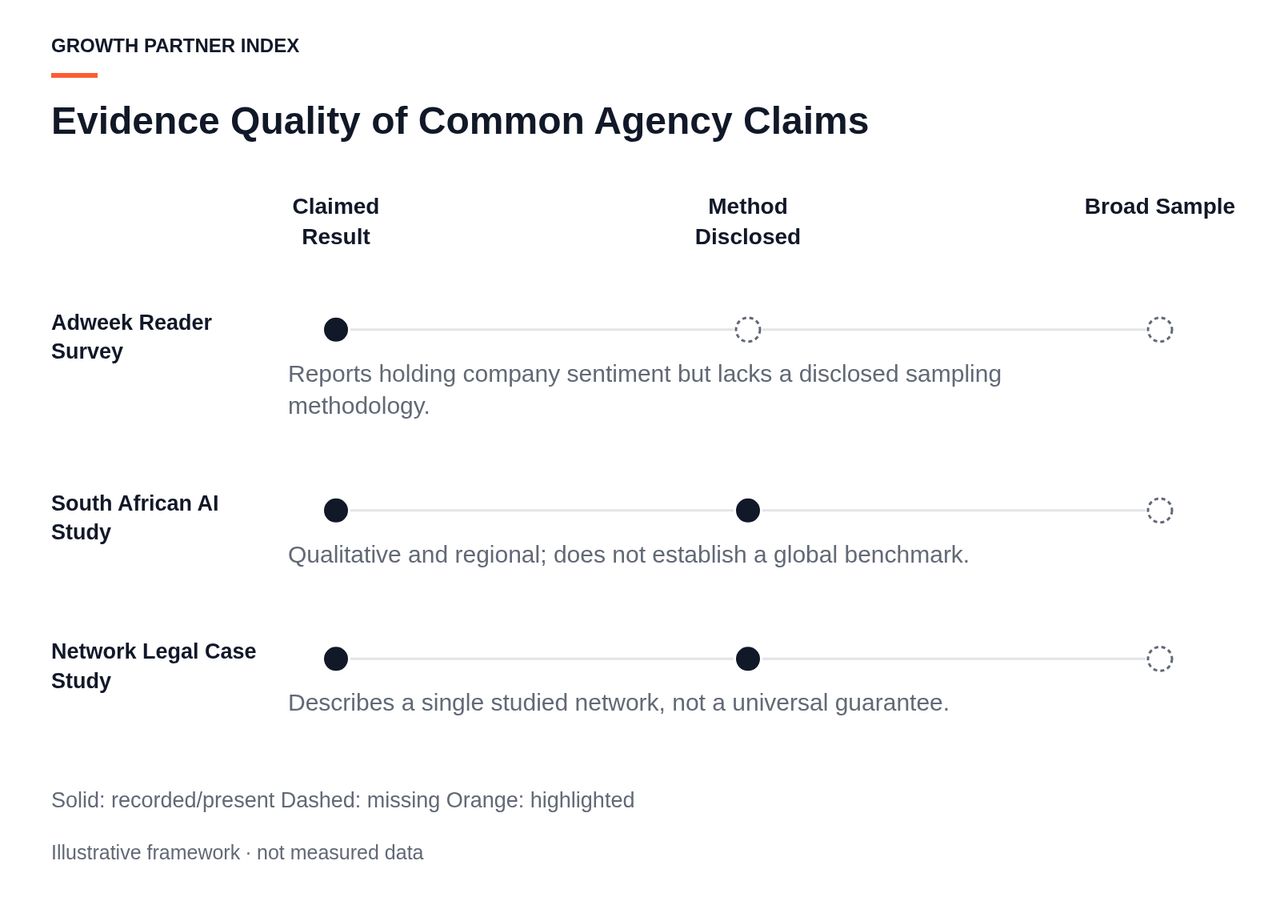
Five conditions reward a large group: simultaneous launches in many markets, where a central team cannot manage local timelines; local-language regulatory review, where in-market staff must sign off claims; in-market trading desks negotiating with local publishers and broadcasters; and heavy production volume that a small studio cannot absorb. The fifth is complex contracting: a case study in the Journal of Media Business Studies describes a network agency drawing on extensive global legal departments to develop professional agency contracts. That is one studied network with an unverified publication date, so it illustrates an asymmetry rather than proving a rule, and it does not show that independents lack contract expertise.
Where scale becomes friction: approvals, cross-unit handoffs and P&L protection
The same bundling that creates leverage creates delay. A group that sells media, strategy and creative as a bundle, in the structure Groas outlines, usually runs those disciplines as separate P&Ls. When your scope changes, the units negotiate transfer pricing and staffing among themselves. You do not see that negotiation; you wait for it. A unit protecting its own margin may also resist releasing a senior person to a sister agency's account.
How scaled independents cover geography, and where that cover fails
Scaled independents cover markets through partner networks, remote senior teams and platform-native buying, where a Google or Meta auction is the same in Madrid as in Manchester. Moburst's account of how smaller shops compete is one independent-side version of this argument. The cover fails in two places: negotiated local inventory, where relationships and volume with in-market publishers matter, and multi-jurisdiction contracting, where a single entity must sign and carry liability across countries.
| Requirement | Holding company advantage | Scaled independent answer | Evidence to request in review |
|---|---|---|---|
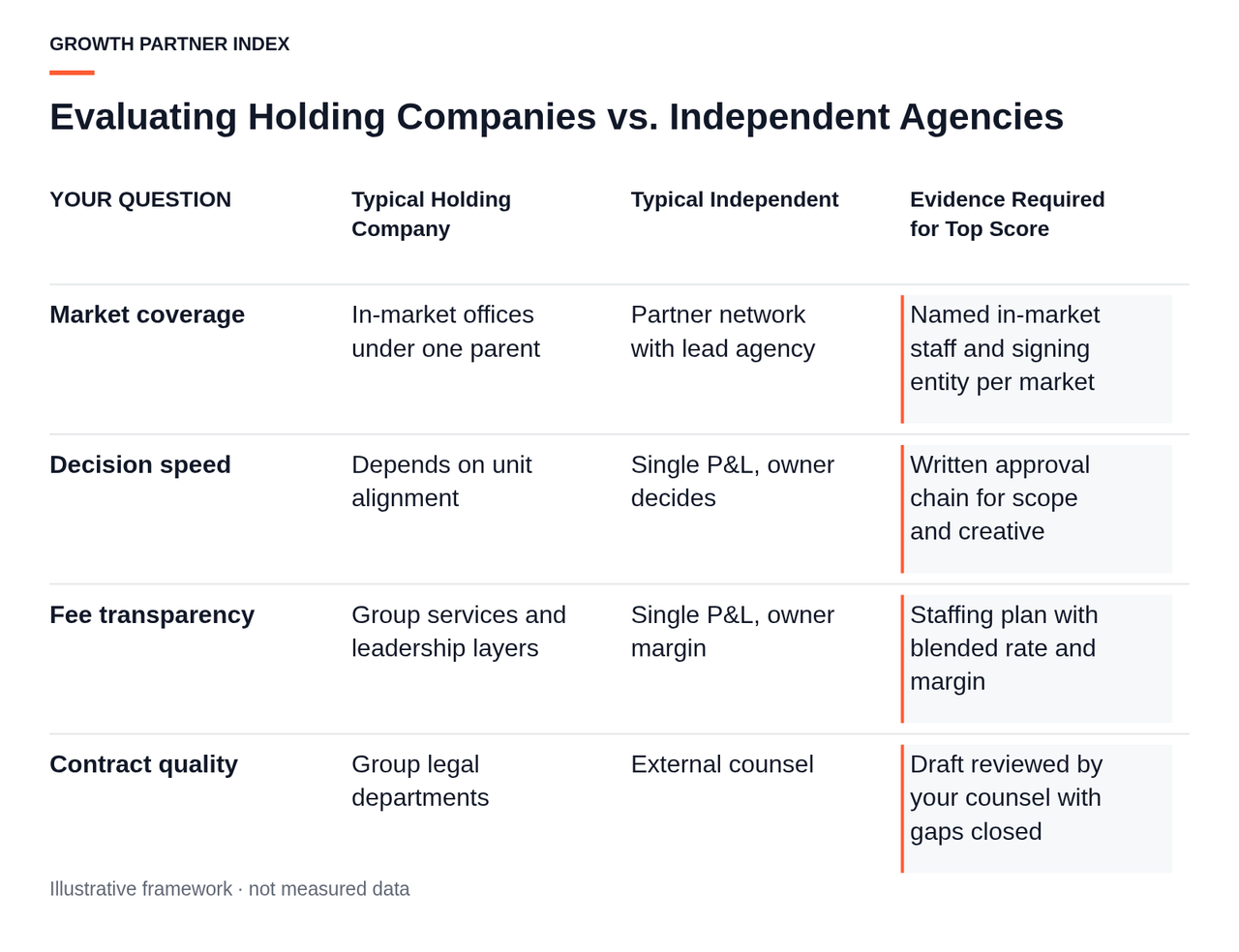
| Launch in many markets at once | In-market offices under one parent | Partner network with a lead agency | Named in-market staff and the signing entity per market |
| Local regulatory review | Local compliance staff | Outsourced legal review | Sample of approved local claims with reviewer named |
| Negotiated local inventory | Group trading desks | Platform-native buying, partner desks | Publisher agreements naming the buying entity |
| High production volume | Group production hubs | Studio partners or in-house team | Capacity plan in hours per month |
| Complex contracting | Group legal departments | External counsel | Draft contract with audit and data clauses marked |
| Fast scope changes | Depends on unit alignment | Single P&L, owner decides | Written approval chain for a scope and a creative change |
The contracting row draws on the network case study; the bundling structure follows Groas's description.
The agility claim is testable. Ask each finalist to write down the actual approval chain for a scope change and for a creative change, with names and titles. An answer that lists one owner is a different product from an answer that lists three group functions.
Cost structures: fees, overhead and media rates are three different questions
Holding company volume discounts are worth the overhead only when the discounted channels are a large share of your plan and the discount is passed through in writing. The answer is conditional because a pitch usually blends three costs that need to be separated.
Fee structure and overhead: who pays for the layers
An agency fee is staff cost plus overhead plus margin. In a bundled, publicly traded group of the kind Groas describes, overhead includes group services, shared centres and leadership layers that a single-P&L independent does not carry. That does not mean the fee is higher. Scale in staff sourcing, including offshore and nearshore hubs, can keep the blended rate competitive. The mistake is comparing headline fees. Ask each finalist for the staffing plan behind the fee: names, levels, allocation in hours, location, and the blended hourly rate that results. Two agencies quoting the same fee can be selling very different amounts of senior time.
Media rates and volume leverage: real, but conditional
Volume leverage works where inventory is negotiated. Upfront commitments and group deals can lower unit rates on linear TV and large publisher packages because the seller values guaranteed spend. On auction-based digital, the marketplace sets the clearing price and buying skill determines efficiency; a group's total spend does not change the auction you enter. So the value of leverage depends on your media mix. A hypothetical illustration: a brand spending seventy percent of its plan in programmatic and paid social gains little from group TV deals, while a brand with half its budget in national broadcast may gain a lot. Those percentages are constructed to show the mechanism, not measured results.
Principal media and undisclosed margin: the transparency test
Principal-based media is inventory the agency buys on its own account and resells to clients. It can lower your rate and it can hide margin, sometimes both at once, and it makes like-for-like rate comparison impossible unless disclosed. Both models use it. The fix is contractual: disclosure of any principal position, rebate pass-through, and audit rights. Expect a group with the legal resources described in the network case study to arrive with mature paper on these points. Review it with your own counsel rather than accepting it because it looks complete. Independent-side essays, such as Curiosity's piece on unlearning holding company habits, argue the cultural case for simpler arrangements; treat them as perspective, not proof.
A neutral way to compare total cost of ownership
Our ledger holds no verified rate benchmark for either model, so we quote none. What produces a fair comparison is a common structure that every finalist prices.
| Cost component | Typical holding company pattern | Typical independent pattern | How to verify in RFP or contract |
|---|---|---|---|
| Staff cost | Mixed onshore and hub resourcing | Smaller, often more senior team | Staffing plan with names, levels, hours and locations |
| Overhead and margin | Group services and leadership layers | Single P&L, owner margin | Blended rate and margin disclosure |
| Negotiated media rates | Group deals on TV and publishers | Partner desks or direct buys | Rate cards and pass-through clause |
| Auction media efficiency | Set by buying skill and tooling | Set by buying skill and tooling | Historical performance with method disclosed |
| Principal media and rebates | Common at group level | Possible, less common | Disclosure clause and audit rights |
| Transaction cost | Longer negotiation, mature templates | Shorter paper, gaps to fill | Time to signature and clauses added by your counsel |
The overhead row follows the bundled structure in Groas's comparison; the template observation reflects the network case study. Patterns are conceptual, not measured averages.
Require every finalist to price the same staffing plan and disclose principal media, rebates and audit rights inside the fee proposal, so cost is compared once rather than argued about later.
AI adoption and technology integration: how to evaluate the claims
Evaluate technology claims by watching the work, using the same client data extract for every finalist and scoring what you see.
Proprietary platforms versus assembled stacks
Holding companies tend to build or acquire proprietary data and AI platforms funded at group level, and industry commentary such as Resonate's note on the Publicis and LiveRamp deal discusses what group data acquisitions mean for independents. Independents tend to assemble best-of-breed tools and platform-native AI, sometimes adopting faster because no group standard has to approve the change. Digiday's reporting on independents shifting to post-cookie tools describes that pattern. The tradeoff: proprietary platforms can offer integration and negotiated data access but create lock-in and may be priced into fees; assembled stacks are portable but depend on the agency's integration discipline.
What published research does and does not show about agency AI use
The one study in our ledger is a 2024 qualitative paper on South African marketing agencies, which reports AI use in content strategy optimisation, content creation, insight integration and personalisation, and process automation. It is regional, self-reported and historical. It does not compare ownership models, give adoption rates or show return on investment. The argument that AI equalises independents against groups, made in pieces such as this strategic essay, is a hypothesis to test in your review, not a finding.
What to ask for: workflow evidence, not slide decks
Request a live walkthrough of a real workflow, from brief to creative variant to media optimisation, showing where humans review and what changed in time or performance, with the measurement method stated.
| Capability claim | Question to ask | Acceptable evidence | Red flag |
|---|---|---|---|
| Proprietary AI platform | What does it do on our data today? | Live session on your extract | Roadmap slides only |
| Faster creative production | How many review points remain? | Recorded workflow with timestamps | Efficiency percentage without method |
| AI-driven optimisation | How is uplift measured? | Test design and control described | Platform-reported lift alone |
| Integrated data | Who owns models trained on our data? | Contract clause | Verbal assurance |
The categories of use in the table reflect the South African study; the evidence standards are our framework.
Data ownership, portability and exit
Cookie deprecation makes this a portability question rather than a prediction. Write into the contract who owns first-party data, models and segments built on it, what is returned at exit and in which format, and whether AI-assisted optimisation is reported with methodology rather than as a platform dashboard figure.
Talent continuity and morale: the durability question buyers underweight
Morale rarely appears on a procurement scorecard, and its cost shows up later as turnover on the account. Ask each finalist for 24-month team retention on comparable accounts and write key-person protections into the contract.
Why morale is a client metric, not an HR metric
Relationship durability depends on the named team staying. When a planner or account lead leaves, the institutional knowledge about your brand, your approvals and your data leaves with them, and the client funds the re-learning through slower work and repeated briefings. Morale is the leading indicator of that turnover, which is why it belongs in a procurement scorecard rather than in the agency's internal reporting alone.
What the 2025 survey data does and does not show
On 3 June 2025 Adweek reported a reader survey in which most people working at holding companies including IPG, WPP, Havas, Dentsu, Publicis and Omnicom described overall morale as negative. An opinion piece in The Current attributes materially stronger morale to independents, citing industry surveys amid consolidation and restructuring.
Both sources carry limits. The Adweek sample is self-selected from its readership, and the excerpt we captured does not disclose methodology or sample size, so we quote no percentage and do not generalise the result to the whole industry. The Current piece is written by an independent agency executive and attributes findings to surveys without exact figures. Together they show that the structure a team works inside appears to affect how the team feels, and they land in a period of consolidation where client teams change mid-contract. They do not show that consolidation causes the morale gap, or that any specific agency will lose your team.
Contract levers for continuity in either model
The protections are the same whichever model you choose.
- Key-person clauses naming the individuals whose departure triggers a remedy.
- Notice periods for any change to the named team, with client approval of replacements.
- Senior time commitments expressed in hours per month, not titles on an org chart.
- Periodic team-stability reporting, so churn is visible before it hurts.
The same levers answer the execution question. Ask which pitch-team members are contractually assigned to delivery and at what allocation. A pitch led by people who will spend two hours a month on the account is a different proposition from a pitch led by the team that will run it, and only the contract makes the difference enforceable. Independent commentary, including the PM360 think tank exchange, tends to frame senior access as an independent advantage; the contract test applies equally to independents whose founders sell the pitch and then move to the next one.
Governance, conflicts and procurement: where the process shapes the outcome
Procurement design decides much of the outcome before capability is scored. Audit your screening criteria for financial gates that exclude candidates early, and have your own counsel review any agency-supplied contract template.
Conflict management: firewalls versus refusal
Holding companies manage competitor conflicts by placing rival clients in separate agency brands inside the bundled parent Groas describes, with firewalls between them. Independents typically refuse direct conflicts. For the client, firewalls buy breadth of category expertise at the cost of sharing a parent with a competitor; refusal buys exclusivity at the cost of a shallower category bench. Ask for the conflict policy in writing and decide which cost you prefer.
Contract asymmetry: who drafted the paper you are signing
The network case study notes that the studied network's global legal departments develop its agency contracts. A well-resourced counterparty arrives with mature templates that protect its positions on audit, rebates and data. Independents may offer simpler paper that omits protections you need. In both cases the fix is the same: your counsel drafts or amends the audit, rebate and data terms rather than accepting the standard form.
Procurement mechanics that favour one model by accident
GPI publishes its own ownership and disclosure statement, the same transparency this section asks agencies to provide.
| Procurement requirement | Effect on holding companies | Effect on independents | Suggested adjustment |
|---|---|---|---|
| Insurance minimums | Met at group level | May exclude capable smaller firms | Set limits to actual account risk |
| Balance-sheet tests | Passed via parent accounts | Screens out single-P&L firms | Replace with escrow or parent guarantee options |
| Single global entity | Delivery spans several entities | Usually one entity | Allow a lead entity with named subcontractors |
| Extended payment terms | Absorbed by group treasury | Strains cash flow | Shorten terms or offer media pass-through billing |
The table is a conceptual framework; the contracting observation reflects the network case study. Separate financial-risk gates from capability scoring so the two do not contaminate each other, and check the reverse bias too: single-supplier processes can penalise a group whose delivery legitimately spans several legal entities. GPI's enterprise RFP template is one place to see how those gates can be structured.
Transparency clauses that work regardless of model
Five clauses apply to both models: audit rights, rebate pass-through, principal media disclosure, subcontractor disclosure and data ownership. Issue the same brief to every finalist so the responses compare like for like.
Restructuring risk: what mergers and reorganisations mean for a live account
Restructuring risk is symmetrical, and the contract should anticipate it before signing. Add a change-of-control clause with termination and transition rights to every agency contract, whichever model you choose.
How consolidation reaches the client team
When a holding company merges brands, changes leadership, consolidates offices or renegotiates group contracts, the client experiences it as team reassignment, new reporting lines and revised terms. The Adweek survey and the commentary in The Current describe the environment in which those changes land; neither shows that restructuring caused the morale they report, and we make no claim about specific pending mergers.
Protections to negotiate before signing
Four terms do most of the work: a change-of-control clause that triggers renegotiation or exit rights when ownership of the agency changes; termination rights on defined key-team changes; transition assistance for a fixed period at agreed rates; and data hand-back terms that specify format and timing.
Independent-side risks: acquisition and founder exit
An agency's independence is only as durable as its ownership. Private-equity acquisition, founder exit or a sale to a holding company can change culture, pricing and priorities within one contract term. Key-person risk is also concentrated in fewer people. If key talent leaves an independent, the contract should already define who approves the replacement, how much notice you receive and how the fee adjusts if seniority falls. Written in advance, those terms convert a founder's departure from a crisis into a managed change.
A weighted scorecard for comparing independent agencies and holding companies
Complete the weights before issuing the RFP and share the scoring rule with finalists, so everyone knows what earns a top score.
Set weights from your requirements, not from the market debate
The nine criteria come from the sections above: market coverage, decision speed, fee transparency, media rate verification, technology portability, team continuity, conflict policy, contract quality and restructuring protection. A brand launching in twelve markets weights coverage and contracting capacity highest, the capability the network case study illustrates. A single-market performance advertiser weights decision speed, continuity and rate verification, with the morale evidence as one input into continuity.
Scoring the evidence, not the pitch
Score each criterion from 0 to 3. A 3 requires documentary evidence: contracts, case data with method disclosed, or a live demonstration. A 2 is partial documentation. A 1 is an unsupported claim. A 0 is a refusal to answer. The model label itself carries no score.
| Criterion | Weight (your input) | Evidence required for a top score | Common unsupported claim |
|---|---|---|---|
| Market coverage | Named in-market staff and signing entity per market | We are everywhere | |
| Decision speed | Written approval chain for scope and creative changes | We are nimble | |
| Fee transparency | Staffing plan with blended rate and margin | Our fees are competitive | |
| Media rate verification | Rate cards, pass-through and audit clause | Our scale gets better rates | |
| Technology portability | Data and model ownership clause, export format | Proprietary platform advantage | |
| Team continuity | 24-month retention on comparable accounts | Low turnover | |
| Conflict policy | Written policy and current client list by category | No conflicts | |
| Contract quality | Draft reviewed by your counsel with gaps closed | Standard terms | |
| Restructuring protection | Change-of-control and transition clauses | We are stable |
The evidence column assembles the requests made in earlier sections; the continuity row uses the Adweek survey as an example of evidence that informs a score while carrying stated limitations.
When to shortlist both models
Run a mixed shortlist when your weights are balanced across coverage and speed, or when you are unsure how much negotiated media you will buy. A common brief, such as GPI's agency pitch brief template, gives every finalist the same problem so the scores mean the same thing.
How GPI documents agencies of either model
Evidence over model labels
GPI documents agencies against the same standard whatever their ownership. The Growth Partner Confidence Score methodology assesses documented evidence, including verified work, disclosed methodology and stated limitations, rather than the model an agency belongs to. The bundled-parent structure that Groas describes is recorded as structure, not as merit, and an independent and a holding company unit are held to the same criteria on operating maturity, team continuity and verified capabilities.
Reading a GPI profile against your scorecard
Profile fields map onto the scorecard. Documented case work informs capability and market coverage. Disclosed methodology informs measurement quality and technology claims. Stated limitations inform how honest the agency is about what its evidence shows, which is the same discipline this article applies to the Adweek survey and the South African AI study. GPI's own ownership disclosure, linked in the procurement section, is the transparency standard we ask agencies to meet.
Use profile evidence as a first pass before issuing your RFP, then require the documents the scorecard names. Choose the structure that fits your requirements, then verify the team and the evidence behind every claim. For the criteria GPI uses to document agencies of either model, see the Growth Partner Confidence Score methodology linked above.
FAQs
Can a mid-market brand access holding company media leverage without appointing a global AOR?
Sometimes, through a group's media unit on a project or single-market scope, but negotiated rates usually attach to committed volume you may not bring. Ask which specific deals would apply to your plan and how pass-through is documented.
How do I verify a media rate claim when the agency uses principal-based buying?
Require disclosure of every principal position, the agency's acquisition cost where permitted, and audit rights over the resale. Without those three, the rate cannot be compared with a disclosed buy.
What retention or continuity data is reasonable to request from a finalist?
Twenty-four-month retention of named staff on comparable accounts, the tenure of the proposed team, and the notice process for changes. Treat morale reporting such as the Adweek survey as context, not as data about a specific agency.
Does joining an independent network give an agency the same delivery guarantees as a holding company?
No. Networks share pitching and referrals without a common balance sheet, so each member is liable only for its own scope. Confirm the signing entity and liability per market.
How should I score a proprietary AI platform against an assembled tool stack?
Score what each does on your data in a live session, then score portability and ownership terms. The available research describes categories of AI use, not comparative performance, so the demonstration is your evidence.
What contract clauses protect a live account during a holding company restructuring?
Change-of-control rights, termination on key-team changes, fixed-period transition assistance and data hand-back terms. Expect mature group templates, as the network case study suggests, and have your counsel amend them.
Should the same RFP financial gates apply to independents and holding company units?
Apply the same risk logic, not the same thresholds. Set insurance and balance-sheet requirements to the account's actual exposure, allow guarantees or escrow as alternatives, and score capability separately from financial risk.
