

Your SEO retainer is up for renewal, and a generative engine optimization specialist has just pitched you on the idea that rankings no longer decide who gets seen.
The pitch has some evidence behind it.
Ahrefs found that the share of AI Overview citations drawn from top-ten organic results fell from roughly 76% in July 2025 to about 38% by March 2026, which means a page can rank well and still not be the source an AI answer quotes.
The question is whether that shift justifies a new category of agency, or whether it changes what you should demand from any search partner.
This article works through what each agency type optimizes, how their reporting differs, how to test a GEO claim, and which of three procurement paths fits your situation.
The GEO-versus-SEO framing does more for agencies than for buyers. Most of the underlying work overlaps, so the label on a proposal says little about whether a partner can find, sample, and report the citations that now shape discovery.
The narrower and more useful question is this: can the agency show, with dated samples and a stated method, how your brand appears in AI answers, and can it explain what that does and does not prove about pipeline?
A partner that answers with one screenshot has not answered. A partner that shows its limitations has earned a pilot, whatever it calls itself.
SEO agency vs GEO agency: Quick answer
- GEO agencies optimize for citations inside LLM answers; SEO agencies optimize for rankings, backlinks and indexable content, according to Mentionable's comparison. The foundations overlap heavily, with one practitioner estimating around 80% shared factors in a video discussion, an opinion rather than a measurement.
- The pressure is real but dated. Pew's March 2025 US panel saw clicks on standard results roughly halve when an AI summary appeared, and Ahrefs recorded top-ten sources falling to about 38% of AI Overview citations by March 2026.
- The label is not the decision. Deliverables, staff, evidence practices and measurement are, as The Rank Collective argues.
- A rebranded SEO agency is the main risk, so vet measurement and structured-content capability, not vocabulary.
- Most buyers should re-scope rather than replace. Reserve a specialist hire for cases where the incumbent cannot demonstrate citation tracking or entity work.
The rest of this piece separates those two questions: whether your current partner can be verified, and whether it needs replacing.
What Changed: Why the SEO vs GEO Agency Question Exists at All
The agency question exists because two things moved at once: fewer searches end in a click, and the pages AI answers cite are drifting away from the pages that rank. Neither finding tells you what is happening in your own funnel, so treat both as dated observations.
How AI Overviews change organic click-through rates
Pew Research tracked the browsing of 900 US adults in March 2025. When a Google result page included an AI summary, users clicked a standard result in 8% of visits, against 15% when no summary appeared.
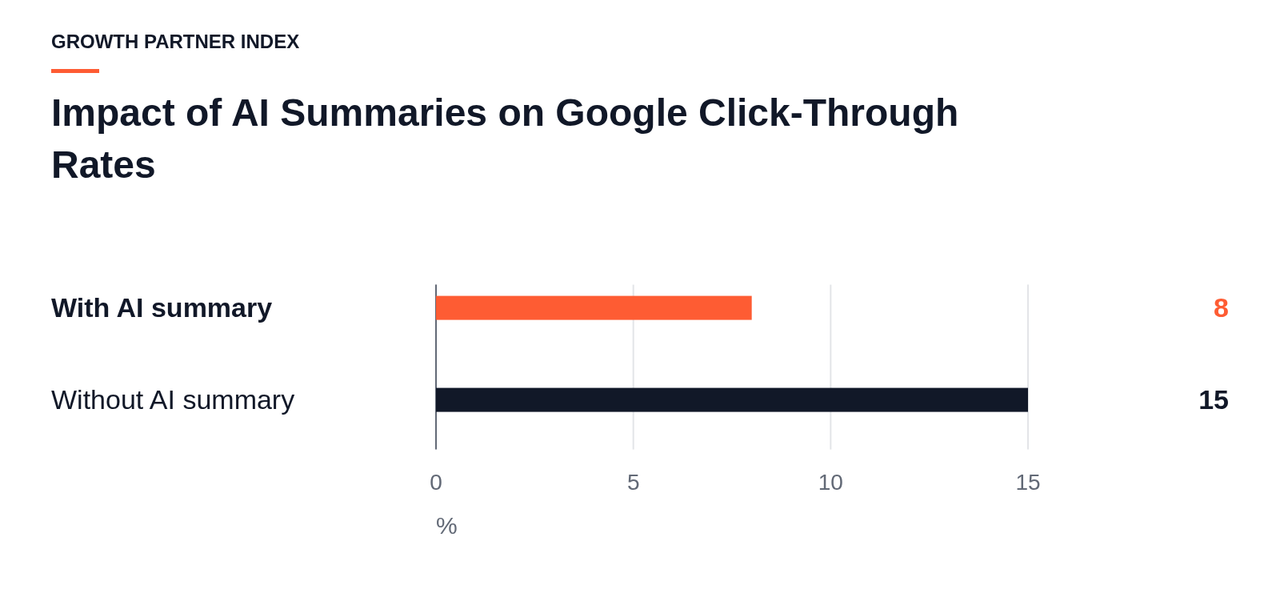
That is a US-only, Google-only, single-month panel, and it describes aggregate behavior. SparkToro's 2026 analysis, published under a title stating that fewer than one third of Google searches still send a click, points in the same direction, though.
The mechanism matters more than the exact figures: when the answer appears on the results page, ranking alone captures less of the demand it used to.
Why high Google rankings do not guarantee AI Citations
Ahrefs analyzed 863,000 keyword SERPs and about four million AI Overview URLs. In July 2025, roughly 76% of AI Overview citations came from the top ten organic results; by March 2026, that share was around 38%.
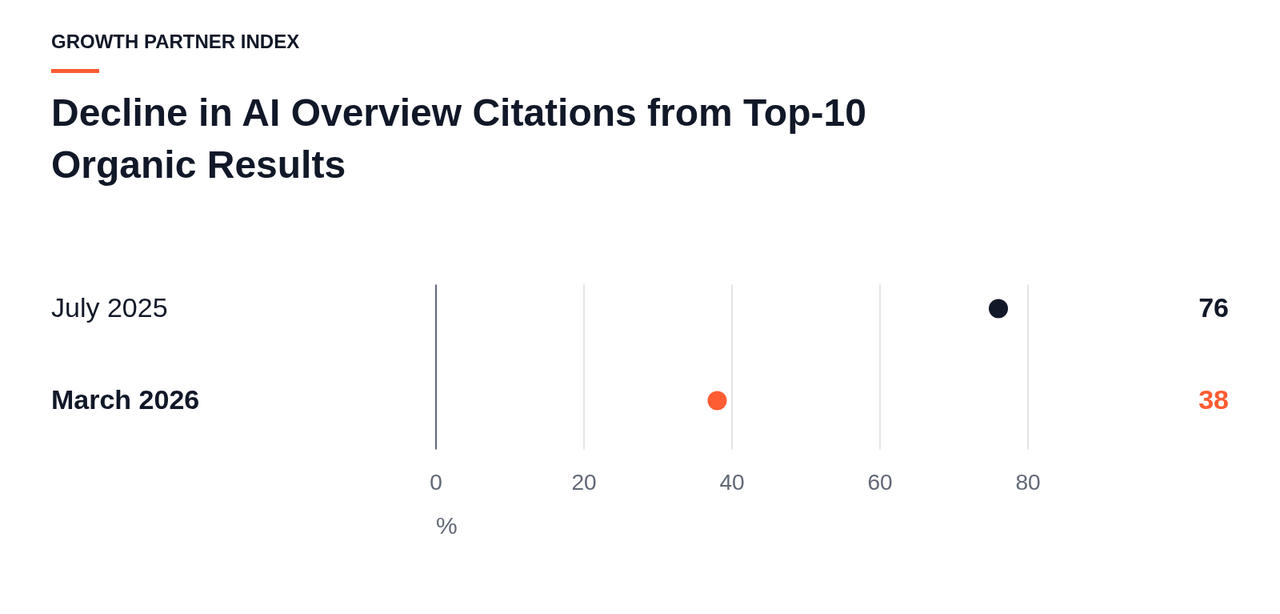
Ranking well still helps, but on its own it no longer secures the citation. That gap between ranking and being cited is exactly the capability agencies are selling into, and it explains why a rank report can look healthy while visibility in AI answers is unknown.
What AI search studies cannot predict about your own business
Both studies are Google-specific. Neither covers ChatGPT, Perplexity, or Copilot, and neither says anything about revenue, lead quality, or brand demand. Aggregates hide category differences, and a study period of a few months in 2025 and early 2026 is not a benchmark for September 2026 or later.
The shift is therefore a procurement question. The amount of content you need has not changed; the measurement and skills required to know whether you are being cited have. Before assuming impact, pull your own branded and non-branded organic click trend for the past 18 months and check whether it matches the aggregate pattern.
SEO Agency vs GEO Agency: What Each Actually Optimizes
An SEO agency works toward rankings, backlinks and indexable content on Google; a GEO agency works toward being cited inside generated answers across engines such as ChatGPT, Claude, Perplexity, Gemini, Copilot, Google AI Mode and AI Overviews, as Mentionable's comparison puts it.
That is an agency blog's framing, but it matches how comparisons from Go Fish Digital and WebFX describe the split. The term itself was formalized in a November 2023 arXiv paper titled GEO: Generative Engine Optimization, a foundational paper describing methods more than today's engine behavior.
What SEO and GEO have in common: crawlability, authority and clear content
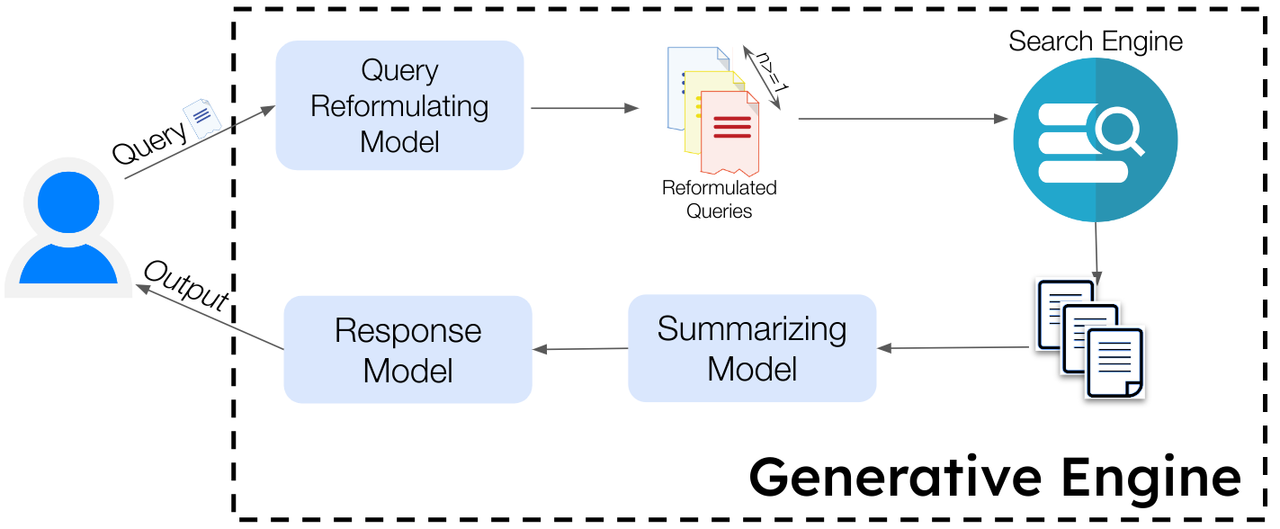
Generative engines still retrieve pages before they summarise them. A page that cannot be crawled, that lacks authority signals, or that buries its point under vague prose is unlikely to be cited by an AI answer for the same reasons it is unlikely to rank.
In a video discussion, Ryan Stewart estimates the overlap between traditional SEO factors and GEO factors at roughly 80%. This expert opinion is not a measurement, but the direction is consistent with how retrieval works.
Where a GEO agency adds beyond traditional SEO
The GEO-specific additions, drawn from competitor guides and best read as practice consensus, are: question research in place of keyword research, direct answers placed early on the page, factual density with sourced claims, consistent entity descriptions of the brand across the web, and structured data that makes those entities machine-readable.
SEO.com's overview frames the shift as optimizing for inclusion in an answer; you're no longer optimizing for position in a list.
| Dimension | SEO agency focus | GEO agency focus | Shared or distinct |
|---|---|---|---|
| Goal | Rankings and organic clicks on Google | Citations and mentions inside generated answers | Distinct |
| Platforms | Google SERP, sometimes Bing | ChatGPT, Claude, Perplexity, Gemini, Copilot, AI Mode, AI Overviews | Distinct |
| Research unit | Keywords and search volume | Questions and prompts users pose to engines | Partly shared |
| Content shape | Topic coverage tuned to ranking intent | Direct answers, factual density, clear entities | Partly shared |
| Off-page emphasis | Backlinks and authority | Backlinks plus consistent brand mentions across cited sources | Largely shared |
| Primary risk | Ranking gains that no longer convert to clicks | Citation claims that cannot be sampled or verified | Distinct |
The platform list and the ranking-versus-citation contrast come from Mentionable; the overlap framing is Stewart's opinion.
Do you need a separate GEO agency?
If most of the work is shared, the incremental capability you are paying a specialist for is narrower than the marketing suggests: a question set, a sampling routine, entity and structured-data work, and a revised content brief.
That is real work, but it is work a competent SEO team can learn. So the decision turns on evidence of those specific capabilities, not on the agency's category.
Map your current statement of work against the GEO column above and mark which items are already delivered.
What Services Does an SEO Agency Provide?
An SEO agency improves a website’s visibility in traditional search results by making it easier to crawl, more relevant to search demand, and more authoritative than competing pages.
The exact scope varies, but a complete SEO engagement normally covers six areas:
- Technical SEO: Auditing crawlability, indexation, site architecture, redirects, canonical tags, internal links, page speed, and other issues that prevent search engines from finding or understanding important pages.
- Keyword and search-intent research: Identifying the queries buyers use, grouping them by intent and mapping them to existing or planned pages.
- Content strategy and production: Building topic clusters, writing briefs, creating new pages and refreshing content that has lost rankings, traffic or relevance.
- On-page optimization: Improving titles, headings, internal links, page structure, copy and metadata so each page answers its target query clearly.
- Authority building: Earning relevant backlinks and mentions through digital PR, partnerships, original research or other off-site activity.
- Measurement and reporting: Tracking rankings, impressions, organic sessions, conversions and the pages contributing to pipeline or revenue.
Local, international and ecommerce SEO may add location management, hreflang implementation, product-feed work or large-scale template optimization. These should appear as named deliverables rather than being hidden inside a generic technical SEO line.
The buyer should be able to connect each service to an output, owner, and reporting metric. “Ongoing optimization” is not a sufficient scope. A proposal should state which pages will be audited or updated, how much content is included, what authority work will be attempted, and how performance will be reported.
What Services Does a GEO Agency Provide?
A GEO agency works to improve how often and how accurately a brand appears in AI-generated answers. Its services should add AI visibility measurement, entity work, and answer-focused content improvements to a sound SEO foundation.
A credible GEO scope normally includes:
- AI visibility baseline: Testing a documented set of buyer questions across named engines to establish where the brand is cited, mentioned, omitted, or described inaccurately.
- Question and prompt research: Identifying the questions buyers ask during research and evaluation, rather than treating a prompt as another name for a keyword.
- Citation and competitor analysis: Recording which sources generative engines cite, which competitors appear for the same questions, and which pages repeatedly earn visibility.
- Entity consistency: Checking whether the brand, products, executives, and areas of expertise are described consistently across the website and relevant third-party sources.
- Content restructuring: Adding direct answers, clearer definitions, sourced facts, comparison tables, and explicit entity references to pages that already serve important buyer questions.
- Technical and structured-data work: Improving crawlability and using appropriate schema to describe known entities and relationships. Structured data may improve machine-readable clarity, but it should not be presented as a guaranteed citation factor.
- Off-site authority work: Strengthening the sources that shape generated answers through digital PR, expert commentary, original research, and credible third-party mentions.
- Cross-engine reporting: Sampling citations and mentions across agreed interfaces, with dates, run counts, cited URLs, and known limitations included in the report.
The overlap with SEO is substantial. A GEO agency should not need to rebuild content strategy, technical foundations and authority work from zero when those functions already operate well. The incremental value lies in cross-engine sampling, entity analysis, answer-focused briefs and a measurement method that can distinguish movement from run-to-run variation.
GEO, AEO, AI SEO and LLM SEO: Are These Different Services?
GEO, AEO, AI SEO and LLM SEO describe overlapping approaches rather than four standardized agency categories. Providers use the labels differently, so buyers should compare the work being delivered instead of treating the terminology as proof of specialization.
- Generative engine optimization (GEO) usually refers to improving visibility, mentions, and citations inside generated answers. The term was formalized in the 2023 paper GEO: Generative Engine Optimization.
- Answer engine optimization (AEO) usually focuses on making content easy to extract as a direct answer across search features, voice assistants, and answer engines.
- AI SEO is often used as an umbrella term for traditional SEO extended to AI Overviews, AI Mode and conversational search interfaces.
- LLM SEO usually refers more narrowly to how brands and sources appear in answers produced by large language model products such as ChatGPT, Claude, Gemini and Perplexity.
In practice, the scopes often converge around clear content, consistent entities, authoritative third-party signals, structured information, and repeated visibility sampling. An agency using any of these labels should still be able to name the engines it monitors, show its prompt set, explain its sampling method, and identify the deliverables that are not already included in traditional SEO.
The procurement question is therefore not which acronym appears on the proposal. It is whether the partner can document the additional work, measurement, and expertise covered by the fee.
SEO Agency vs GEO Agency Reporting Differs
SEO agencies focus on rankings and clicks, whereas GEO agencies report citations and LLM visibility. As such, reporting is where the two disciplines diverge most in practice, and where a buyer can see the gap without any technical audit.
What a traditional SEO report can and cannot show you now
A rank-and-session report still answers a real question: where do we appear on Google, and how many visits did that produce? What it can no longer show is visibility that produces no sessions.
Pew's March 2025 panel, cited earlier, found clicks on standard results roughly halved when an AI summary appeared, so flat or falling sessions may coexist with persistent visibility. Worse, Ahrefs' finding that most AI Overview citations now come from outside the top ten means rank tracking can miss the very pages being cited, whether they are yours or a competitor's.
What a credible GEO report should contain
A credible GEO report is a sampling record.
It should list the prompt or question set used, the engine and interface queried, whether the brand was cited or merely mentioned, the URL cited, which competitors were cited for the same prompt, and the sampling method and date.
Generated answers vary between runs, so a single response is not an outcome; The Rank Collective makes that warning explicit.
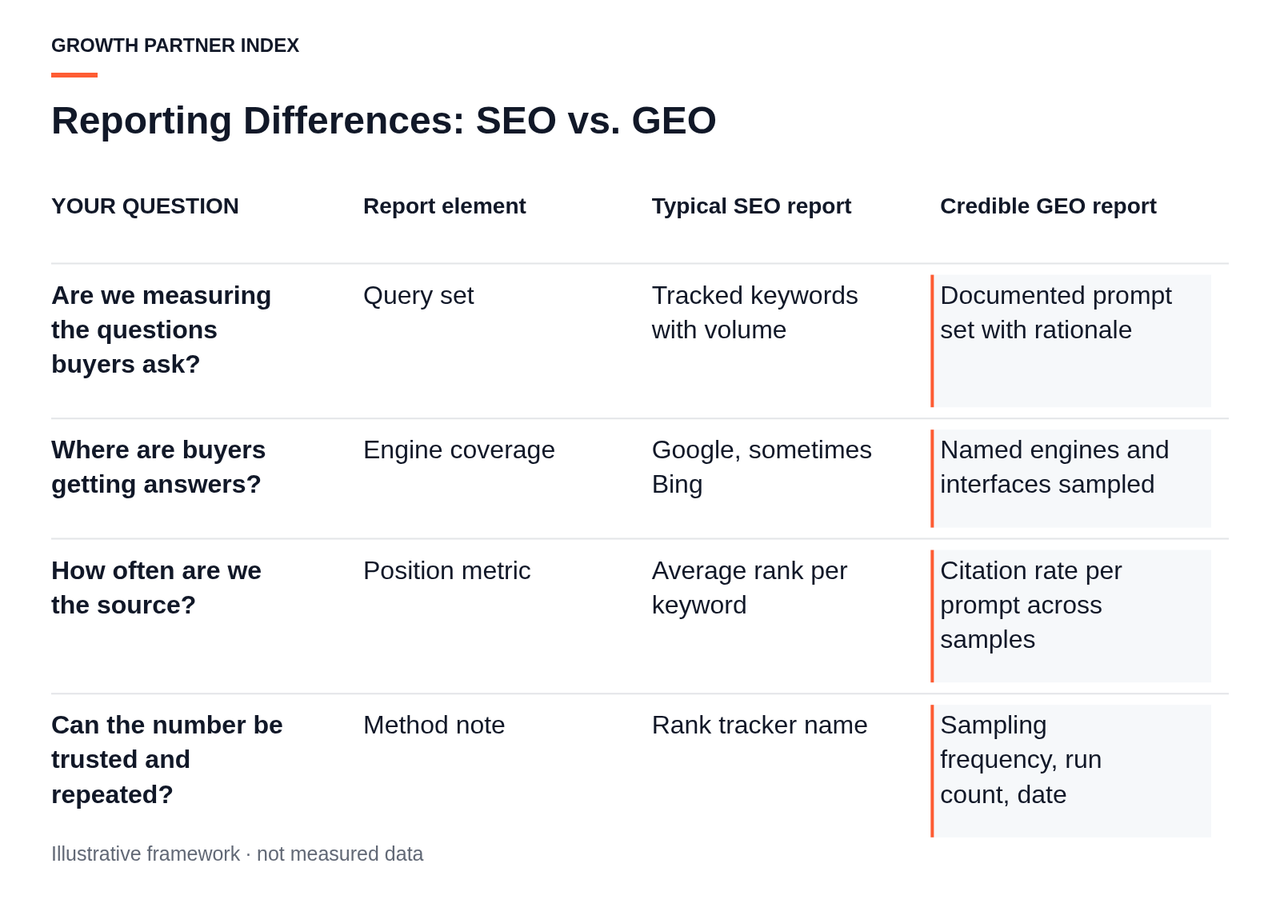
| Report element | Typical SEO report | Credible GEO report | Business question it answers |
|---|---|---|---|
| Query set | Tracked keywords with volume | Documented prompt set with rationale and owner | Are we measuring the questions buyers ask? |
| Engine coverage | Google, sometimes Bing | Named engines and interfaces sampled each period | Where are buyers getting answers? |
| Position metric | Average rank per keyword | Citation rate per prompt across repeated samples | How often are we the source? |
| Source detail | Ranking URL | Cited URL and competitor citations for the same prompt | Which pages earn citations, and who beats us? |
| Method note | Rank tracker name | Sampling frequency, run count, date, known variance | Can the number be trusted and repeated? |
| Outcome link | Sessions and conversions from organic | Citation share as a leading indicator, with stated limits | What can we claim to finance? |
The distinction between rankings and citations follows Mentionable; the insistence on method over single responses follows The Rank Collective.
How to connect AI citations to pipeline without overclaiming
Treat citation share as a leading indicator; it's not revenue. It can be tied to assisted conversions or branded search demand only where the agency states its method and its limitations, and revenue should not be attributed to citations without a test design such as a holdout by category or region.
Take this example: if sampled citation rate for a product category rises from 10% to 30% over a quarter while branded searches for that category also rise, the report may note the correlation, but it cannot claim the citations caused the demand without controlling for campaigns and seasonality.
On cost, this article has no captured pricing evidence, so it makes no claim about whether GEO retainers cost more. Request one sample monthly report from any prospective or incumbent agency and check it against the table before discussing fees.
How to Tell Whether a GEO Agency Has Real Capability
Because the overlap is large, any SEO agency can plausibly adopt the GEO label without adding capability. That makes rebranding the central buyer risk, and it makes verification, not vocabulary, the test.
The agency comparison from The Rank Collective puts the principle plainly: review deliverables, staff, evidence practices and measurement, and ignore the label. GPI's buyer guide to evaluating an AI search agency covers the broader evaluation; this section narrows to the rebrand question.
Questions to ask a GEO agency before hiring it
Ask these of your incumbent before any RFP and score each answer as weak or strong.
| Question to ask | Weak or rebranded answer | Strong answer | Evidence to request |
|---|---|---|---|
| Who runs citation sampling, and how often? | We check ChatGPT when we report | Named analyst, fixed prompt set, scheduled runs, repeated samples per prompt | The sampling log with dates and run counts |
| Which engines do you track, and why those? | All of them, or the main ones | A stated list tied to where our buyers research, with a reason for each inclusion and exclusion | The engine list and rationale from an existing client report, anonymized |
| How is entity and structured-data work scoped? | Included in technical SEO | A specific audit of brand entity consistency, schema coverage and about-page facts, with deliverables | A sample entity audit and schema change list |
| What changed in your content brief template? | Our briefs are already optimized for AI | A brief that specifies the question answered, the direct answer placement, sourced facts and entity mentions | The current brief template beside the previous version |
| How do you separate variance from movement? | The number went up, so it worked | A stated run count per prompt and a threshold below which changes are treated as noise | The method note from a monthly report |
| What does a citation prove about pipeline? | It drives leads | It is a leading indicator; here is how we test it and what we cannot claim | A written limitations statement |
The review-deliverables-not-labels standard and the caution against treating one generated response as proof are drawn from The Rank Collective.
Evidence a GEO agency should provide
Four things distinguish capability from vocabulary:
- Dated before-and-after citation samples for a real client, with the prompt set and engines named, even if the client is anonymized.
- A methodology note that describes sampling frequency, run count, and how variance is handled.
- Named staff who do the work, not a partner who presents it.
- Stated limitations: an agency that volunteers what its numbers cannot show is more credible than one that promises outcomes.
A time-bounded evaluation, which The Rank Collective recommends, lets you check whether these artifacts arrive on schedule rather than only in the pitch.
GEO agency red flags that look like proof
Some evidence looks convincing but proves little:
- A single screenshot of ChatGPT mentioning a client. One generated response is one sample from a distribution; the next run may differ.
- Guarantees of citation share. Engines change retrieval behavior, and the Ahrefs shift in citation sources over eight months shows how fast the ground moves.
- Proprietary AI claims with no method. A tool name is not a methodology.
- Dashboards with no sampling date or run count. A number with no date cannot be compared to anything.
- Ranking case studies relabelled as GEO results. Rankings and citations are related, but not the same, and the Ahrefs data shows they can diverge.
None of this assumes bad faith. A capable team will already have these artifacts, so asking for them costs little.
How Much Does a GEO Agency Cost Compared With SEO?
A GEO agency does not automatically cost more than an SEO agency. The price depends on whether GEO is added to an existing SEO retainer, purchased as a limited pilot, or delivered as a separate program with content production, digital PR, and cross-engine monitoring.
Published 2026 pricing guides illustrate how wide and unreliable category-level ranges can be. GoodFirms places SEO retainers across a range from approximately $500 to more than $15,000 per month, with many providers charging between $1,500 and $5,000. WebFX places GEO agency services between $1,500 and more than $50,000 per month.
These are provider-reported market guides, and the GEO range combines very different business sizes and service levels.
A useful comparison prices the actual scope:
| Cost component | SEO agency | GEO agency | What to clarify |
|---|---|---|---|
| Initial audit | Technical, content and authority audit | Citation baseline, prompt set and entity audit | Is this a one-off project or included in the retainer? |
| Content work | Keyword-led briefs, new pages and refreshes | Answer-focused briefs, source improvements and restructuring | How many pages or briefs are included each month? |
| Technical work | Crawlability, indexation, architecture and schema | Shared SEO foundations plus entity and structured-data review | Which work is genuinely incremental? |
| Authority work | Backlinks, digital PR and third-party mentions | Sources and mentions that influence generated answers | Is outreach or digital PR included? |
| Measurement | Rankings, impressions, sessions and conversions | Citations, mentions, cited URLs, competitors and variance | Are tool fees and raw sampling data included? |
| Reporting | Search performance and business outcomes | Cross-engine visibility with methodology and limitations | How often are engines sampled, and how many runs are performed? |
The least expensive path is usually to add defined GEO deliverables to a capable SEO retainer because the technical, content, and authority foundations are already funded. A separate specialist may be justified when the incumbent cannot establish an AI visibility baseline, document citation sampling or perform entity work.
A fixed-term pilot can test those capabilities before the company commits to another open-ended retainer.
When comparing proposals, ask each agency to separate three figures:
- The cost of work already included in SEO
- The incremental cost of GEO-specific deliverables
- Any software or data fees
Without that breakdown, a buyer may pay twice for content, technical work, and authority building that both proposals describe under different names.
Should You Keep Your SEO Agency or Hire a GEO Specialist?
Once you have scored the rebrand test, the decision falls into one of three paths, each with its own conditions and tradeoffs.
Retain your SEO agency when it already reports on citations
If the incumbent answered strongly on sampling, engine coverage, and content briefs, and can produce dated citation samples, retain it. Given the large overlap that Stewart describes in his discussion of shared factors, this is likely the default outcome for many buyers: the team already does most of the work and has extended its factor set rather than rebuilt it.
Retaining still deserves a written expectation: citation reporting in every monthly report, an entity audit within the quarter, and a named owner of the prompt set.
Hire a GEO specialist when the incumbent cannot show the work
Hire when three conditions hold together:
- Discovery in your category is answer-engine heavy, meaning buyers research through conversational tools before they search transactionally.
- The incumbent has no cross-engine tracking and could not produce a methodology note.
- Your budget can support a time-bounded pilot with defined artifacts and a review date, which The Rank Collective recommends over open-ended engagements.
Specialists exist across the market; lists such as Citeme's and Grizzle's for B2B show how crowded the label has become, which is precisely why the pilot, not the shortlist, does the vetting. Apply the same evidence standard GPI describes in its methodology: documented practice over claimed results.
Require GEO in a re-scoped retainer when the gap is measurement
The third path fits the most common situation: the incumbent delivers strong rankings and clear content but cannot say which engines it samples or how often.
Here the gap is measurement.
Add citation reporting, an entity audit, and structured-data deliverables to the existing statement of work, name the prompt-set owner, and set a review date.
A conceptual example: a marketing director whose agency ranks well but has no sampling routine adds a six-month clause requiring documented citation sampling across three named engines, with the option to go to market if the artifacts do not arrive.
Applicability and durability
Two further considerations shape the choice, both stated as our internal reasoning.
- On applicability, informational and B2B research-heavy categories are likely to feel the shift first, since those queries are the ones generative answers handle well; transactional and local queries with clear commercial intent may see less change, though local discovery through AI interfaces is also evolving.
- On durability, prefer work on factual clarity, entity consistency, and page structure, which serve both classic and generative retrieval regardless of model updates, over tactics tied to one interface's current behavior.
Pick one path, write down the trigger conditions that would make you revisit it, and set a 90-day review.
How to Integrate GEO Into an Existing SEO Program
Whichever path you choose, the work lands in one content operation. The shared foundations that Stewart describes in his overlap discussion mean restructuring existing pages almost always precedes producing parallel content. A single pipeline avoids the most common failure, which is two teams publishing conflicting pages on the same question.
Audit your SEO efforts before adding GEO
Start with a joint audit before jumping to new content.
- Baseline current citations. Agree a prompt set of buyer questions, choose the engines to sample and run each prompt several times on a dated schedule to establish a starting citation rate for you and named competitors.
- Audit entity consistency and structured data. Check that the brand, products, and people are described consistently across your site, third-party profiles, and any cited sources, and that schema reflects those facts.
- Revise content briefs. Require the question to be answered, a direct answer near the top, sourced facts, and explicit entity mentions, then apply the brief to existing high-value pages before commissioning new ones.
- Add citation sampling to monthly reporting, alongside rankings and sessions, with the method note attached.
- Review quarterly, comparing citation movement to rank movement and to demand signals.
Add AI citation tracking and entity work to your current workflow
Governance decides whether the sequence holds.
- Name who owns the prompt set and how it may change, because a shifting prompt set makes trend lines meaningless.
- Document sampling in a log rather than a slide.
- Decide in advance how to interpret disagreement: if rankings hold while citations fall, the likely issue is content shape or entity clarity; if citations rise while rankings fall, check whether the cited pages are the ones you intended and whether sessions are being replaced by branded demand.
As The Rank Collective cautions, no single response settles either question.
How often should you measure AI search visibility?
Generated answers vary run to run, so a monthly change of a few points in citation rate may be noise. Set a threshold based on your run count below which changes are recorded but not acted on.
Two failures recur here:
- Reporting that mixes sampled citations with analytics sessions in one chart without labeling
- Parallel content programs that fragment authority
Integration is an operating model change, which is why the partner's documented evidence matters more than the partner's category. Schedule the joint audit with your agency, covering entity consistency, structured data and a baseline citation sample, before anything else is added to the retainer.
How GPI Reads SEO and AI Search Agency Claims
Whether a proposal says SEO, GEO, AEO, or AI search, its value rests on documented measurement and structured, entity-aware execution.
GPI reads agency claims the same way it reads any claim: against the evidence offered, the methodology behind it, and the limitations the agency is willing to state. A citation screenshot is an anecdote until it is part of a dated, repeated sample, and a ranking case study is not proof of AI visibility.
Consider two shortlisted agencies:
- One is labeled GEO and shows AI answers mentioning clients but cannot describe its sampling method.
- The other is labeled SEO and produces monthly reports with a documented prompt set, named engines, run counts, and a limitations note.
The evidence favors the second, whatever the first calls itself, and the Rank Collective's advice to judge deliverables and measurement over labels points the same way.
Judge shortlisted agencies on documented citation-measurement practice rather than on branding. The GPI SEO & AI Search category is a starting point for reviewing documented SEO and AI search agency capabilities.
FAQ
What should a citation sampling methodology statement include before we accept AI visibility numbers in a monthly report?
At minimum: the prompt set and who owns it, the engines and interfaces sampled, the number of runs per prompt, the dates of sampling, how a citation is distinguished from a mention, and a statement of known variance. Without run counts and dates, a percentage cannot be compared month to month.
Can a traditional SEO agency credibly add GEO within an existing retainer, and what contract clauses make that accountable?
Yes, given the large overlap in foundations. Make it accountable with clauses that name the deliverables (citation report, entity audit, structured-data changes, revised brief template), the delivery dates, the prompt-set owner, and an exit or re-tender option if the artifacts do not arrive by the review date.
How long should a time-bounded GEO evaluation run before we judge whether citations are moving?
No captured evidence sets a benchmark. Reasoning from run-to-run variance and content revision cycles, a quarter is the shortest period in which restructured pages can be re-crawled and sampled enough times to separate noise from movement; six months gives a fairer test. Fix the period in advance.
Which parts of GEO work are likely to survive model and interface changes, and which are tied to a single engine?
Factual clarity, consistent entity descriptions, direct answers, and structured data serve any retrieval system and should endure. Prompt phrasing tricks, formatting tuned to one interface's current display, and tactics based on a single engine's citation pattern are the parts most exposed to change.
If organic clicks fall while citations rise, how do we explain the tradeoff to finance without claiming causation?
Present both as dated observations: sessions from a measured analytics source, citations from a sampled record with its method attached. Add branded search demand and assisted conversions as context, state that correlation is not attribution, and propose a holdout test if finance wants a causal estimate.
Is GEO worth prioritizing for a transactional or local business, or mainly for research-heavy categories?
Research-heavy and B2B categories are likely to feel generative discovery first, because those are the questions AI answers handle well. Transactional and local businesses should keep foundations strong and add citation sampling at low cost, but the case for a specialist hire is weaker there. This is reasoning, not measured evidence.
