
A CMO comparing a performance creative agency with a UGC platform usually receives two proposals that do not describe the same purchase. The platform quote covers seats, creator matches and per-asset licenses. The agency quote covers a retainer or production fee for a stream of tested ads. Both sit inside a market that has expanded quickly: IAB projected creator economy ad spend of $37 billion in 2025, up about 26 percent year over year and roughly four times the growth rate of total media. That growth explains why so many suppliers now exist. It does not tell you which one fits your team. This article separates what each model sells, what each costs once internal hours are counted, and how fast either one has to move to keep ads alive on Meta and TikTok.
Most comparisons of agencies and UGC platforms are written by one side of the trade, so they line up prices and features and skip the question that decides the outcome: who turns last week's media data into next week's brief, and how quickly. A platform lowers the cost of finding creators. It leaves the cost of deciding what to make exactly where it was. An agency sells that decision loop, and the fee is only worth paying when your spend and fatigue cadence exceed what your own team can brief, review and evaluate. Judge either option on documented cadence, rights terms and reporting that isolates creative effects from attribution noise, rather than on a ROAS screenshot.
TL;DR: agency or platform?
If you have one strategist, one editor and a modest paid social budget, a UGC platform is usually the answer; if spend has outgrown the hours your team can give to briefing and evaluation, a performance creative agency or a hybrid is. The short version:
- A UGC platform sells creator access and content rights. A performance creative agency sells a managed testing loop: strategy, editing, iteration and reporting.
- Total cost includes the hours your team spends briefing, reviewing and editing platform-sourced content, not just seats versus retainer.
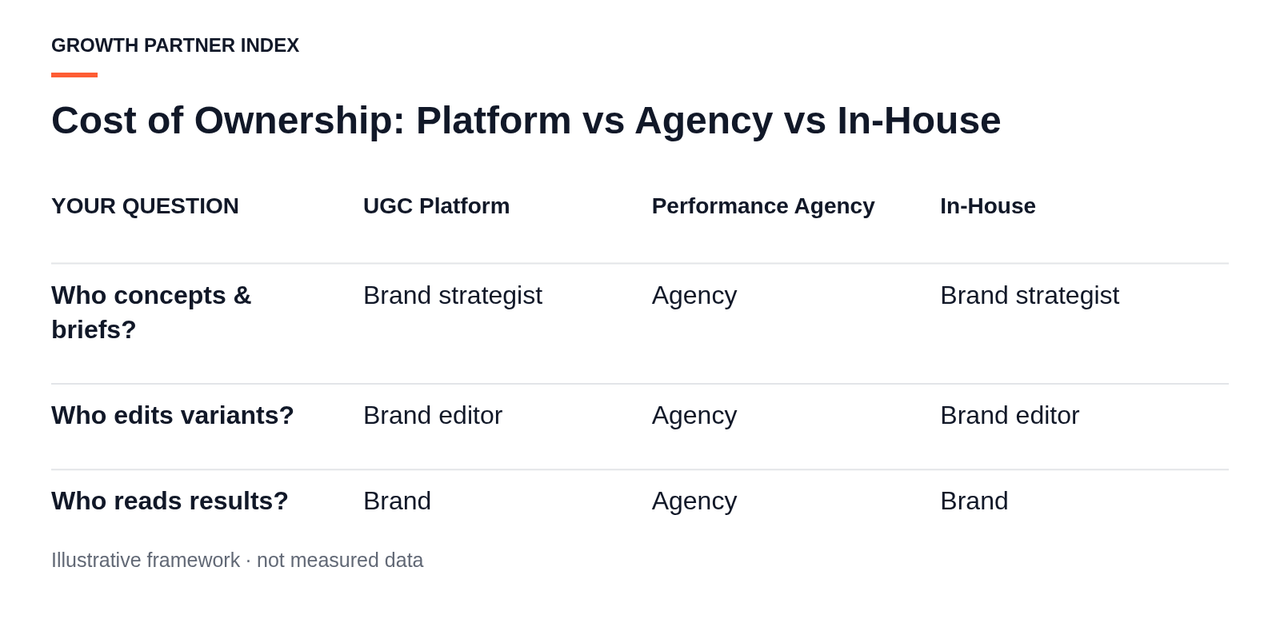
- Consumer campaigns on TikTok often saturate within 7 to 10 days, according to platform research cited by Marpipe. That window sets the minimum iteration cadence either model must sustain.
- Platforms fit brands that have a strategist and editor but lack creator supply. Agencies fit brands whose spend has outrun their capacity to run the loop.
- Hybrids are common: platform for volume sourcing, agency or in-house team for concept strategy and post-production.
- Judge any provider on documented iteration cadence, rights terms and reporting, never on claimed ROAS.
What each model actually sells: rights, strategy and distribution
Before requesting proposals, write down which of three things you are short of: assets, a working iteration loop, or audience reach. The two models sell different combinations of the first two and neither sells the third.
UGC platforms sell creator supply and licensed assets
In the performance sense, UGC means video produced by creators for the brand's own paid accounts. The creator is a supplier, and the brand pays media costs to distribute the result. That is a different purchase from influencer marketing, where the brand rents the creator's audience. Cost comparison guides such as influencerfee.com's UGC versus influencer breakdown treat the two as separate line items for that reason.
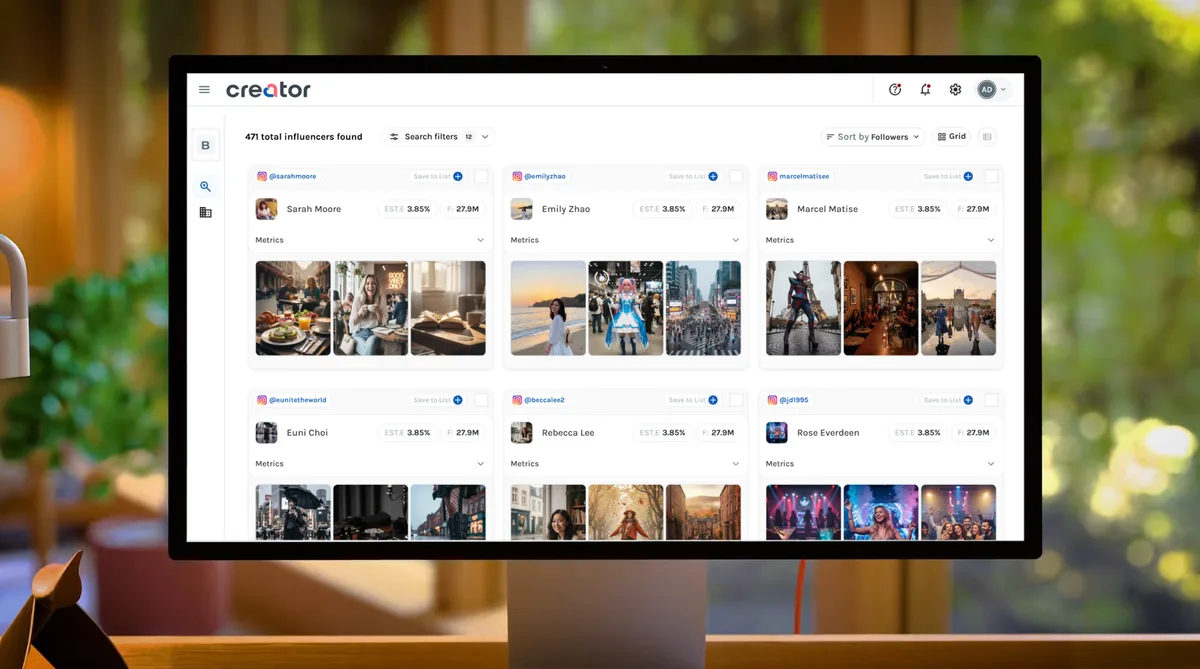
A platform's deliverable is a marketplace plus tooling: matched creators, brief templates, delivery of raw or lightly edited videos, and a usage license with defined terms. Workflow guides written by platforms, such as Creator.co's comparison of UGC platforms, describe the job as finding and working with creators. That framing is accurate, and it also marks the boundary. Concept selection, brief quality, editing and reading results stay with whoever is using the software.
Performance creative agencies sell the iteration loop
An agency's deliverable is the loop itself: concept strategy grounded in account data, creator sourcing, editing and variant production, feedback from media performance and reporting on what to make next. Agency roundups such as New Engen's list of UGC creative agencies for paid social describe these services in the agency's own vocabulary, so translate them into steps and ask who performs each one. The creators may come from the same pool a platform would offer. What you are paying for is the judgment and labor wrapped around them.
Neither model sells audience reach
UGC purchases content rights, not distribution. Whether the video came from a platform or an agency, your media budget carries it to an audience. Some agencies also manage media, and some platforms offer creator whitelisting for paid amplification, but those are separate services with separate fees. Keeping the boundary clear stops a proposal from looking cheap because it omits distribution, or expensive because it bundles it.
The context for all of this is a supply boom. IAB's November 2025 report projected creator economy ad spend of $37 billion for 2025, growing about 26 percent year over year. That figure describes the whole creator market, not your category, and it is a projection rather than a measured result. It does explain why both supply models have multiplied and why sorting them by what they actually deliver matters.
Total cost of ownership: seats, retainers and the hours nobody budgets
Fill the worksheet below for one quarter using your loaded hourly rates and target iteration cadence, then compare cost per tested concept across models rather than cost per video. Agency-published pricing guides exist, including Darkroom's 2026 overview of agency costs by service, but they are marketing documents from sellers and are not treated as benchmarks here. The framework uses your own numbers.
Platform costs: subscription, per-asset fees and rights extensions
The visible platform costs are the subscription or seat fee, a per-asset or per-creator fee, and any premium for faster turnaround or higher-tier creators. The less visible cost is rights. Licenses commonly run for a fixed term, and a winning ad that keeps performing past that term needs an extension at a price set later, when your negotiating position is weak because the ad is already working. The largest hidden cost is labor: strategist hours to develop concepts and write briefs, editor hours to cut variants from raw footage, and reviewer hours to approve every round.
Agency costs: retainer or per-asset production plus strategy fees
Agencies price as a monthly retainer, a per-asset production fee, a strategy fee, or some combination. The retainer typically bundles briefing, creator management, editing and reporting, which is why it looks expensive next to a platform seat. The hidden costs are different in kind: onboarding weeks before the first useful brief, approval latency on your side that the agency cannot control, and lock-in when the agency holds the record of what has been tested and why.
The management overhead line item
| Cost component | UGC platform | Performance creative agency | In-house | Who bears the hours |
|---|---|---|---|---|
| Access fee | Subscription or seats | Retainer | Salaries | Finance line, no hours |
| Creator payment | Per asset, often marked up | Inside retainer or per asset | Direct to creator | Brand or agency admin |
| Concept and brief | Not included | Included | Included | Brand strategist or agency |
| Editing and variants | Not included, or basic add-on | Included | Included | Brand editor or agency |
| Review and approval | Brand | Brand, on agency drafts | Brand | Brand always |
| Usage rights | Per asset, per term | Often bundled, check term | Negotiated per creator | Brand or agency legal |
| Reading results and re-brief | Brand | Agency, with brand data access | Brand | Whoever owns the loop |
The table shows what the seat price hides: three of the seven rows carry no fee on a platform because the work is left to your team. The worksheet turns that into a number.
Cost per tested concept equals provider fees for the period, plus internal hours multiplied by loaded hourly rate, divided by the number of distinct concepts that actually launched. Count concepts, not videos, because ten hook variants of one idea teach you far less than three different ideas.
A hypothetical worksheet, with invented hours purely for illustration: a brand whose top ad sets need a fresh concept every 7 to 10 days runs roughly four to six cycles per month per campaign. If each concept consumes two strategist hours, three editor hours and one reviewer hour on a platform, three concepts per cycle across five cycles means about ninety internal hours a month before any video is bought. Under an agency, the internal hours might drop to review and data access, perhaps one hour per concept, but the retainer rises. The comparison only becomes honest when both columns include every row above. You can track these inputs quarter by quarter with GPI's agency performance evaluation template, which is built around documented outputs rather than impressions of effort.
The cross-over point moves with spend. At low media budgets, a slow iteration cycle wastes little, because the fatigued ad is not spending much. As monthly spend rises, every extra day a stale ad runs costs more in wasted delivery than the same day of agency fee. That is why the same agency can be an indulgence for one brand and a saving for another, and why the decision cannot be read from a rate card.
Creative testing velocity: fatigue sets the cadence each model must hit
Measure your current time from a performance insight to a live replacement variant this month, and mark whether it is shorter than the 7 to 10 day saturation window for your top spending ad sets. Cost per concept is a question of money; this section is about time and throughput.
What the 7 to 10 day saturation window implies
Creative fatigue is mechanical. An ad launches, the delivery algorithm finds the users most likely to respond, and early results look strong. As those users are exhausted, frequency rises, click-through falls, and CPM and CPA drift upward because the system is now paying to reach people who were less responsive to begin with. Marpipe's October 2025 explainer on creative fatigue cites TikTok's own research that consumer-facing campaigns often reach saturation within 7 to 10 days. Treat that as a platform average and a cadence reference, not a guarantee. Small audiences and high budgets fatigue faster; broad audiences and low budgets fatigue slower. The practical implication holds either way: whichever model you choose has to deliver a meaningful refresh inside a window about as long as a typical approval cycle.
The reason cadence matters so much is that creative quality is a large lever on outcomes. Meta's Facebook IQ has published research arguing that higher-quality creative increases ad ROI, and NCSolutions' 2023 e-book identifies creative as one of its five keys to advertising effectiveness. Neither source studies UGC operating models specifically, and the NCS work predates today's short-form platforms, so use both as context for why creative throughput deserves budget rather than as benchmarks.
Variant depth versus concept breadth
Not every refresh costs the same. A variant refresh changes the hook, the caption, the first three seconds or the call to action while keeping the core idea. TikTok publishes creative best practices that work well as a checklist for this kind of iteration. A new concept changes the argument the ad makes: a different pain point, format, creator persona or proof. Variants are cheap and buy days. Concepts are expensive and buy weeks. Platforms are efficient at variants because they lower the cost of getting more footage from more creators. Without an in-house strategist, they are weak at concepts, because no one in the software is deciding what the next idea should be.
Where each model breaks under velocity pressure
An agency's velocity advantage is specific: it turns the media readout into the next brief before the current ad is fully saturated. That advantage disappears if your approval cycle is longer than the fatigue window. An agency that can brief and produce in five days, waiting nine days for sign-off, is slower than the ad it is meant to replace. Platforms break differently. Footage arrives on schedule and stalls in an editing queue, because the platform never owned that step.
Run a velocity audit as an ordered check:
- Pick your three highest-spending ad sets.
- For each, record the date the last performance signal appeared and the date a replacement variant went live.
- Compare the gap against the 7 to 10 day reference.
- Note where the days were spent: concepting, briefing, production, editing or approval.
- Circle the step that consumed the most days. That step, not the fee, is what your operating model must fix.
Who manages the creators: workflow ownership in each model
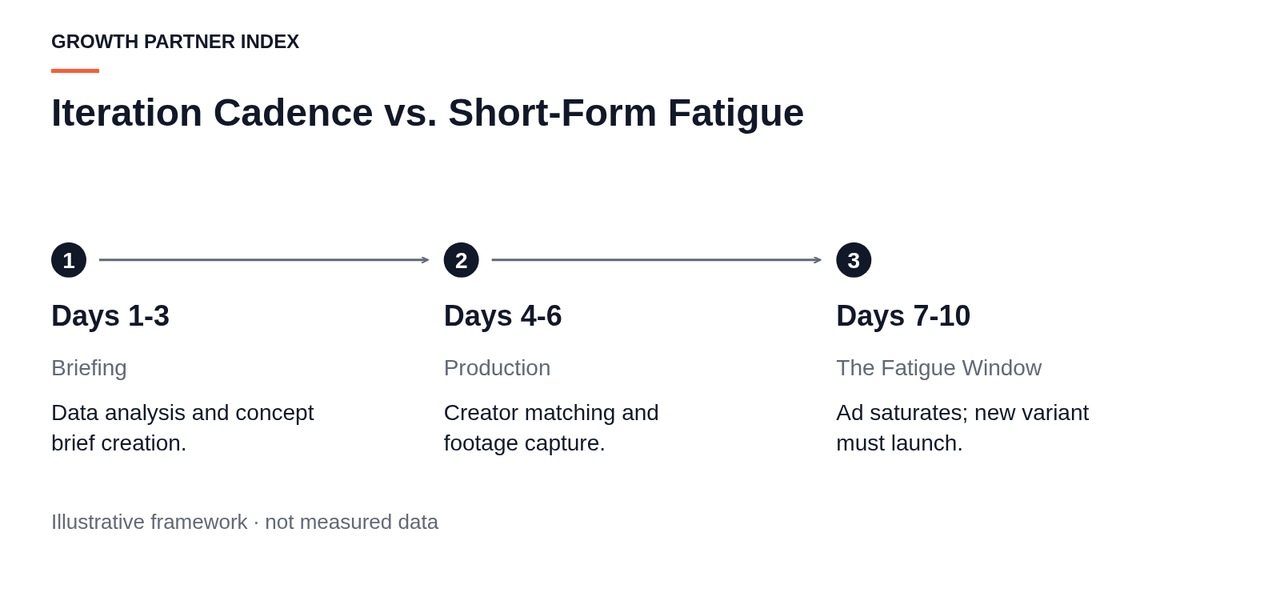
Assign a named owner to each of the nine workflow steps below under your preferred model, then look for any step with no name next to it. The unowned step is where assets will stall.
| Workflow step | UGC platform | Performance creative agency | Hybrid |
|---|---|---|---|
| 1. Concept | Brand strategist | Agency, with brand input | Brand or agency strategist |
| 2. Brief | Brand, using platform templates | Agency | Brand or agency strategist |
| 3. Creator match | Platform tooling, brand selects | Agency network or platform | Platform tooling, brand selects |
| 4. Production | Creator, brand manages revisions | Creator, agency manages revisions | Creator, brand manages revisions |
| 5. Review | Brand | Brand approves agency drafts | Brand |
| 6. Edit and variants | Brand editor | Agency | Brand editor or agency |
| 7. Launch | Brand media team | Agency or brand media team | Brand media team |
| 8. Read results | Brand | Agency with data access | Shared |
| 9. Re-brief | Brand strategist | Agency | Whoever owns concepts |
The table maps ownership only; it makes no claim about any specific vendor's features.
Platform workflow: your team is the producer
On a platform, software reduces search cost. It does not reduce production labor. Your team writes the brief, answers creator questions, runs revision rounds, cuts the footage into ad-ready variants and decides what to make next. Platform-side guides, including Billo's playbook on pitching UGC to clients, tend to describe this work as straightforward, and for a team with a strategist and an editor it is. A lean DTC team without an editor discovers the gap the hard way: raw creator videos accumulate unpublished because step six has no owner.
Agency workflow: a managed loop with approval gates
Under an agency, the brand's job compresses to two things: approving drafts and providing data access. That compression is the value. It also moves the bottleneck. If approvals wait for a weekly meeting, the loop runs at the pace of the meeting. And when the agency owns steps one, eight and nine, it holds the record of what was tested and why, which is a real switching cost unless the contract requires learnings to be documented and handed over.
Hybrid workflow: platform supply, owned strategy
Many mid-size teams run a hybrid: platform for creator volume, an in-house or agency strategist owning concepts and post-production. The pattern works when steps one, six and nine have clear owners and the platform is confined to steps three and four. Whoever owns the re-brief step controls whether the 7 to 10 day cadence is met. Decide that ownership first and the rest of the table tends to fall into place.
Briefs, rights and compliance: where authenticity goes wrong
Add the rights and disclosure checklist at the end of this section to your next platform or agency contract review. Nothing here is legal advice; it is a list of questions that, left unasked, produce expensive surprises.
Brief quality determines authenticity more than the sourcing model
Authenticity is mostly a briefing outcome. An over-scripted brief produces stiff, on-camera reading on any model, from any creator pool. A brief that states the audience, the pain point, the proof to include and the claims to avoid, then leaves delivery to the creator, produces natural content on any model too. Platforms shift the briefing burden onto the brand, which is fine if a strategist owns it and harmful if a coordinator fills in a template. Agencies carry the burden, so ask to see their actual briefs before judging their reel. As the creator market has grown toward IAB's projected $37 billion in 2025 ad spend, creator supply has become plentiful; brief quality has not.
Usage rights, term length and paid-media whitelisting
Settle these in either contract: license duration, permitted channels, edit rights, access to raw footage, extension pricing agreed in advance, and which entity holds the license if an agency negotiated it. Picture a hypothetical winning ad paused after 90 days because the platform license expired and extension pricing was never fixed. Agencies often bundle rights and review into the fee; platforms typically price rights per asset and per term. That difference feeds directly into the total cost worksheet earlier in this article.
Disclosure and claims review
Sponsored content needs disclosure regardless of who sourced it. Regulated categories need claims review before production, not after a video is shot. Decide who reviews scripts and who signs off on claims under your chosen model.
Pre-contract checklist for an RFP:
- License term, channels and edit rights, with extension pricing stated.
- Raw footage delivery and ownership.
- Named owner of brief quality.
- Named reviewer for disclosure and regulated claims.
- Handover of test records and learnings at contract end.
Which model fits your spend, team and velocity: a decision matrix
Locate your row in the matrix below, then record the switch signal you will monitor over the next two quarters. Spend bands are described as conditions rather than dollar thresholds, because the crossover depends on category, margin and audience size.
| Your situation | Spend band | In-house strategy/editing capacity | Required cadence | Recommended model | Switch signal |
|---|---|---|---|---|---|
| Testing channel, few ad sets | Low, fatigue costs little per day | Strategist and editor available | Refresh every few weeks is tolerable | UGC platform | Editing backlog grows or top ad sets start needing weekly refreshes |
| Scaling, spend rising quarter on quarter | Mid, stale days now cost real money | No dedicated strategist or editor | New concept inside the 7 to 10 day window | Performance creative agency | Agency fee exceeds estimated wasted spend saved, or approval latency exceeds the window |
| Mature, multiple always-on campaigns | High, fatigue is the main efficiency leak | Strategist in house, editing partly outsourced | Continuous concept and variant flow | Hybrid with owned learnings | Test records live only with the vendor, or concept breadth stalls while variants pile up |
The cadence column references the 7 to 10 day TikTok saturation window cited by Marpipe as a platform average from 2025 research; your own ad sets may differ.
Low spend, in-house strategist: platform
When daily waste from a fatigued ad is small and someone in the building can concept, brief and edit, the platform's lower access cost wins. The risk is quiet: the strategist gets pulled onto other work, the editing queue grows, and the platform bill keeps coming while assets go unpublished. Watch the backlog, not the invoice.
Rising spend, no strategist or editor: agency
Once spend rises to the point where a week of stale creative costs more than a week of agency fee, and no one internally owns concepts, the agency's loop pays back. This holds even when the headline fee looks steep. A brand whose top ad sets need new concepts within the fatigue window but whose internal approval cycle runs two weeks belongs in this row or the hybrid row regardless of price, because the constraint is throughput. The switch signal runs both ways: if approval latency on your side stays longer than the window, the agency cannot deliver its advantage, and if wasted-spend savings shrink below the fee, the retainer stops earning its place.
High spend, mature team: hybrid with owned learnings
Mature teams usually keep concept strategy and the test record in house, use a platform for creator volume, and add agency capacity for post-production or specific formats. The condition that makes this work is documented ownership of learnings. If the record of what has been tested lives only in a vendor's slides, you have an agency relationship with extra steps.
What the matrix cannot decide is talent. Two agencies in the same row can produce very different work, and no spend band predicts creative judgment. That requires reviewing actual ads against their briefs and checking the documented process behind them. GPI's buyer guide to choosing a performance creative agency sets out the questions for that review.
How GPI evaluates performance creative partners before you sign
You are choosing who owns the testing loop, so any provider should be able to show you how they run it. Shortlist candidates and request four documents before any pricing discussion: iteration cadence records for a comparable account, sample briefs, standard rights terms, and reporting that separates creative performance from media and attribution effects.
Evidence over claims: cadence, rights and reporting
Cadence records show how many days pass between a readout and a live replacement, which is the number the earlier velocity audit asked you to measure for yourself. Sample briefs reveal whether authenticity is designed or hoped for. Rights terms tell you what a winning ad will cost to keep running. Reporting that isolates creative effects matters because an attribution lift after a new batch of ads does not prove the ads caused it; media changes, seasonality and measurement settings all move the same numbers. GPI's methodology scores agencies on documented evidence of this kind rather than on self-reported results, and the ownership disclosure explains how the index is funded so you can weigh that too.
Reading agency profiles against your matrix row
Individual profiles, such as the one for Admiral Media, present what a shop documents about its services and process, so you can check claims against your row in the matrix instead of accepting a reel. GPI has not run campaigns with any listed agency and does not vouch for outcomes; the profiles are evidence to evaluate. Your own total cost worksheet and velocity audit remain the decision basis.
Explore GPI's Performance Creative and UGC agency category to compare documented profiles against your decision matrix row.
Frequently Asked Questions
Can a brand run a UGC platform and a performance creative agency at the same time without duplicating cost?
Yes, if each owns different workflow steps. Use the platform for creator matching and production volume, and the agency for concepts, editing and re-briefing. Duplication appears when both source creators for the same campaign or both produce variants of the same idea. Write step ownership into both contracts and review it quarterly.
How do we keep creative learnings when switching from an agency to a platform or in-house team?
Require a test log as a contract deliverable from day one: concept, hypothesis, launch date, spend, result and the decision taken. Ask for briefs and raw footage on handover. If the log does not exist yet, request a reconstruction before notice is given, while the agency is still motivated to cooperate.
What usage-rights terms should be non-negotiable when buying UGC through a platform for paid media?
A defined license term with extension pricing fixed up front, explicit paid-media and whitelisting permission across the channels you use, edit rights, and delivery of raw footage. Without pre-agreed extension pricing, your best ad becomes your weakest negotiating position.
How should we separate creative performance from media and attribution effects when judging either model?
Hold media settings constant while testing creative, compare new concepts against a control ad in the same ad set and period, and read relative movement rather than absolute ROAS. Treat attribution lifts as a signal to investigate, not proof of causation, and ask providers to report in the same way.
At what point does approval latency inside our own organization make an agency's velocity advantage irrelevant?
When your sign-off cycle is longer than the fatigue window for your top ad sets. If drafts wait nine days for approval against a reference window of 7 to 10 days, the agency's production speed is wasted. Fix approvals first; otherwise you are paying for velocity you cannot use.
Does UGC sourced through a platform require influencer distribution to work, or is paid media alone sufficient?
Paid media alone is sufficient and is the default. UGC in this sense is content licensed for your own accounts. Influencer distribution is a separate purchase of the creator's audience, with its own fee and its own measurement. Combine them only if you want both effects and can budget for both.
What documentation should a performance creative agency show to prove its iteration cadence?
A dated test log for a comparable account showing readout dates and launch dates, sample briefs tied to specific media findings, and a sample monthly report that separates creative results from media changes. A reel proves taste; the log proves cadence.
