

Most paid media agency pricing conversations start with the wrong question. Buyers ask what a fair monthly fee looks like, agencies answer with a retainer or a percentage of spend, and both sides move on to scope.
The number that decides whether the relationship pays for itself rarely comes up: the unit the fee is priced on.
One widely shared summary of agency pricing counts six primary fee structures, and every one of them is priced on an input, whether hours, months, media spend, or a platform-reported conversion. Advertisers are buying something else, which is profitable growth.
This article explains:
- Why each standard model rewards behavior the advertiser does not want
- How to read circulating cost ranges without treating them as targets
- What to check in a proposal before signing
- How to choose and renegotiate a structure that fits your budget stage and tracking maturity
TL;DR: Paid Media Agency Pricing Models Fail Advertisers
- Agencies price almost entirely on inputs. A common summary counts six fee structures, with the monthly retainer described as the most common, and none of them is priced on the advertiser's margin.
- Percent of spend pays the agency more when the budget grows, whether or not returns improve. On a small budget, the same percentage can quietly consume a large share of the media itself.
- A retainer with no defined deliverable count hides how little execution the fee buys. The definition of what is included matters more than the headline number.
- Pure performance fees move risk to the agency, but they steer work toward easily measured, low-funnel conversions and depend on tracking many advertisers do not yet have.
- The fix is a structure chosen by stage and tracking maturity, with an explicit fee-to-media ratio, counted deliverables, and a scheduled review trigger.
The Paid Media Agency Pricing Models You Will Actually Be Offered
Paid media agencies typically use hourly rates, project fees, monthly retainers, percentage-of-spend fees, performance-based pricing, or hybrid combinations. Each model divides delivery, measurement, and financial risk differently between the agency and advertiser.
Start by classifying whatever fee you currently pay, or have been offered, by the unit it is priced on. The rest of the analysis follows from that classification. Pricing summaries such as Taskip's count six primary structures and describe the monthly retainer as the dominant one; in practice, you will meet those structures in three families.
Time-based models: hourly pricing and monthly retainer
The hourly model is the simplest input model. The agency tracks time and bills accordingly. The same summary quotes a span of $50 to over $400 per hour for digital marketing work in 2026, and that figure should be read as one blog's stated range with no disclosed sample; it's not a market benchmark.
The monthly retainer converts time into a fixed monthly amount for an agreed scope. What you are buying is availability across a period.
Whether that period contains twelve creative refreshes and weekly bid reviews, or nothing countable at all, depends entirely on how the scope is written. Two retainers at an identical monthly price can therefore buy very different amounts of work.
Spend-based models: percent of media and tiered management fees
Percent of media charges a fixed share of what you spend on the platforms. A tiered management fee is the same idea with steps: a set fee for each spend band, which softens the ratio at higher budgets but keeps spend as the priced unit.
Both are easy to administer and both scale automatically, which is why agencies like them and why buyers should read them closely.
Outcome-linked models: project, performance and hybrid pricing
- A project fee prices a defined result, such as an account rebuild or a launch campaign, delivered once.
- A performance fee prices a measured outcome, typically a share of attributed revenue, a cost per acquisition bonus or a ROAS threshold.
- A hybrid combines primitives, most often a base retainer plus a performance component.
Because hybrids are assemblies of the models above, their incentives can be analyzed piece by piece rather than as a novel category.
| Model | What the fee is priced on | Who carries the delivery risk | What the advertiser can verify | Typical failure mode |
|---|---|---|---|---|
| Hourly | Hours logged | Advertiser | Timesheets, if provided | Hours grow without output growing |
| Monthly retainer | Months of availability | Advertiser | Deliverables, if counted | Undefined scope hides under-delivery |
| Percent of media | Media spend | Advertiser | Spend and fee invoices | Fee rises with budget, not with returns |
| Tiered management fee | Spend band | Advertiser | Spend against tier thresholds | Incentive to push spend to the next tier |
| Project fee | A defined deliverable | Shared | Acceptance of the deliverable | Scope disputes at handover |
| Performance fee | A measured conversion metric | Agency | Platform reports, unless reconciled | Optimising the metric instead of margin |
| Hybrid | A mix of the above | Shared | Each component separately | Weakest component sets the behaviour |
The table draws on the structures described by Taskip and on the warning from Stackmatix that the ratio of fee to media and the definition of included work are the two things to read before signing. Extract those two numbers from every proposal you hold: the total fee as a share of media, and the count of things the agency has committed to deliver.
Why Paid Media Agency Pricing Models Fail Advertisers
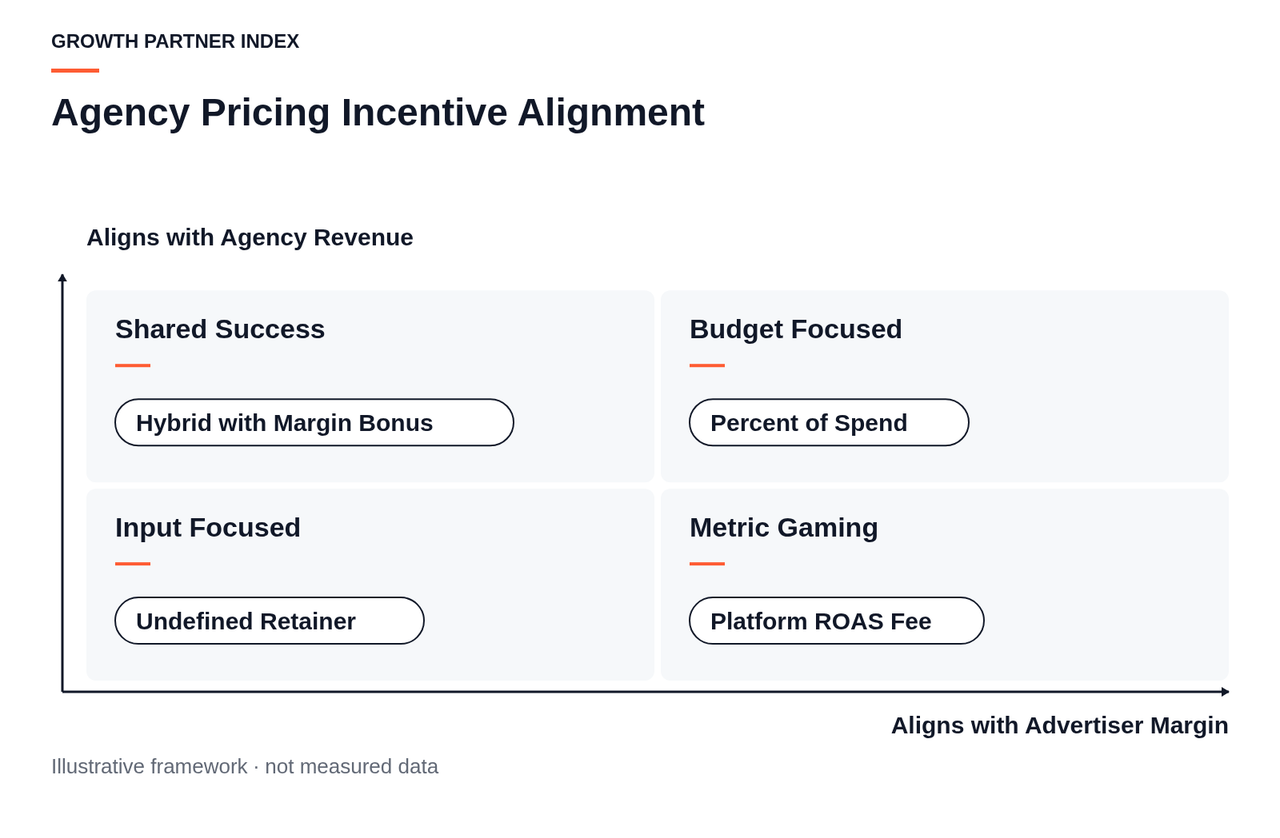
Most pricing models tie agency revenue to hours, contract duration, ad spend, or attributed conversions rather than incremental profit. Misalignment occurs when the agency can earn more without improving contribution margin after media and fees.
A fee model is a measurement decision wearing a commercial disguise.
Whatever the agency is paid on becomes the number it optimizes. Pay on spend, and you have chosen to measure spend. Pay on platform ROAS, and you have accepted the platform's attribution as if it proved causation.
Neither answers the question a CMO actually holds, which is whether the program returned more contribution margin than it cost, fees included.
GPI's position is that pricing deserves the same scrutiny as any other agency claim:
- What evidence does it produce?
- What method sits behind that evidence?
- Where does the method stop working?
A contract that cannot be reconciled to the advertiser's own revenue ledger is misaligned, however reasonable the percentage looks on paper.
Percentage of spend: fees rise with the media budget
If the fee is a fixed share of media, agency revenue moves one-for-one with budget and zero-for-one with efficiency.
Consider a hypothetical brand paying 15 percent of spend that raises its monthly media from $50,000 to $100,000. Agency fees move from $7,500 to $15,000 whether blended customer acquisition cost improved, held, or worsened.
The agency has every reason to recommend the increase and no contractual reason to question it. The fee-to-media ratio stays at 15 percent, which looks stable, but the absolute fee has doubled for the same advisory effort.
The small-budget version of the problem is worse.
Agencies often set a minimum fee beneath the percentage, and Stackmatix warns that on a small budget such a fee can quietly consume half your media. When half of what you send the agency never reaches an auction, reach, learning data, and creative testing all shrink, and the program is judged on a fraction of its apparent budget.
Monthly retainers: vague scopes can hide limited execution
A retainer pays for a month of relationship. If the scope says the agency will provide ongoing optimization and be available for calls, you have bought a promise. Availability is a condition of doing work, but it's not a deliverable.
An undefined retainer therefore hides under-delivery indefinitely: the invoice is identical in a month of daily testing and a month of automated rules running unattended. Stackmatix makes the same point in advising buyers to read the definition of included work before anything else.
The agency's incentive under an undefined retainer is retention, and retention is served by reassurance. It's not served by the uncomfortable test that might show a channel is not incremental.
Performance fees: attribution can replace incrementality
Performance pricing can align interests, but the fee keys to a measured metric, and measured metrics are produced by attribution systems with known biases.
A fee tied to platform-reported ROAS or attributed revenue rewards whatever the platform credits most generously: retargeting audiences who were already returning, branded search that captures demand created elsewhere, and view-through conversions that would have happened anyway.
None of that is fraud, but none of it is proof of incremental margin either.
GPI's guidance on evaluating agency performance by profit rests on the same principle: attribution is a claim about correlation. It's not evidence of causation, and any fee keyed to it inherits the platform's measurement bias. A pure performance fee also depends on the advertiser's tracking being clean enough to pay against, which many programs cannot yet assert.
| Model | Agency revenue rises when | Advertiser margin rises when | Point of conflict | Contract clause that reduces it |
|---|---|---|---|---|
| Percent of spend | Budget grows | Return per dollar grows | Budget can grow while return falls | Fee-to-media ceiling with a cap on absolute fee |
| Retainer | Contract renews | Work produces incremental results | Fee identical regardless of output | Counted deliverables with monthly attestation |
| Performance fee | Attributed metric grows | Incremental margin grows | Attribution can grow without incrementality | Metric reconciled to finance data, holdout tests permitted |
| Hybrid | Whichever component dominates | Incremental margin grows | Weakest component sets behavior | Outcome component gated on reconciled revenue |
The conflict points summarize the mechanism described by Stackmatix; the clauses are GPI's suggested remedies rather than sourced market practice. Fill in this table for your own contract and identify the single clause that would most reduce the conflict. That clause is your first negotiation ask.
What Should Be Included in a Paid Media Management Fee?
A paid media management fee should clearly cover named channels, campaign setup, optimization, testing, reporting, meetings, and strategic oversight. Creative production, software, data, landing pages, and tracking implementation should be identified as included or separately billed.
There is no universal paid media management package. One agency may include creative testing and tracking support in its retainer, while another may charge separately for everything beyond campaign management.
The issue is whether the proposal makes the boundary visible before the contract begins.
Services commonly included in the management fee
The core management scope should identify the platforms covered and the recurring work the agency will perform. Depending on the engagement, that may include:
- Campaign planning and account setup
- Audience, keyword, and competitor research
- Budget allocation and bid management
- Campaign monitoring and optimization
- Testing plans and experiment analysis
- Tracking and attribution reviews
- Performance reporting
- Strategy and account meetings
Each activity needs a cadence or output. “Creative testing,” for example, should state how many concepts or variations the agency will launch each month. “Performance reporting” should specify the delivery date, data sources, and whether results will be reconciled with the advertiser’s revenue data.
Costs commonly billed separately
Media spend is normally paid to the advertising platforms rather than included in the management fee. Other costs that may sit outside the retainer include:
- Creative production and editing
- Landing page design and development
- Third-party reporting or attribution tools
- Audience data and research platforms
- Server-side tracking implementation
- Creator, influencer, or licensing fees
- Travel and on-site production
- Work outside the agreed channel or market scope
Separating these costs is not automatically a red flag. Leaving them undefined is. The proposal should name each likely pass-through cost, who holds the vendor license, whether the agency adds a markup, and which expenses require advertiser approval.
How to make the scope measurable
Replace every activity that cannot be counted with a minimum commitment. “Ongoing optimization” becomes a weekly account review and a documented monthly testing plan. “Creative support” becomes a defined number of concepts and variations. “Strategic guidance” becomes a quarterly planning session with written recommendations.
The contract needs to make under-delivery visible. If neither party can determine whether the promised work happened, the management fee is paying for availability, whereas you want it to pay for an accountable scope.
How Much Does a Paid Media Agency Cost?
Paid media agency costs vary with ad spend, channel count, creative production, reporting, and measurement complexity. Compare total fees, included deliverables, pass-through costs, and the fee-to-media ratio; don't focus on the monthly retainer alone.
Can published agency pricing ranges be trusted?
Published ranges provide broad market context, but they rarely disclose scope, sample size, creative requirements, or included costs. Use them as reference points only.
For instance, the one hourly range in this article's evidence base, $50 to over $400 per hour, comes from a pricing summary with no disclosed sample, method, or collection date. That is typical. Most cost guides that rank for pricing queries are written by agencies or agency marketplaces, including pages from Element Three, WebFX, Darkroom, Digital Applied, and Clutch.
Some, such as Walker Media, are candidly a single agency explaining its own rates. Databox published a retainer fee discussion in 2023 that is now historical context rather than a current benchmark.
None of the captured sources provides an original, dated dataset of paid media fees, so every range here is context. Ranges tell you that dispersion is wide; they cannot tell you what your program should cost.
What is the fee-to-media ratio?
The fee-to-media ratio is calculated by dividing total recurring agency fees by monthly ad spend. It shows how much of the program budget pays for management and makes differently structured proposals easier to compare.
To normalize proposals:
- Add every recurring charge the agency will invoice, including management fee, tooling, reporting, and any creative retainer.
- Divide by planned monthly media.
- Then count the deliverables the document commits to.
A hypothetical $6,000 retainer on $30,000 of media is a 20 percent ratio; a hypothetical $9,000 retainer on $120,000 of media is 7.5 percent. The second costs more per month and is far cheaper per dollar of media working.
Neither ratio is right or wrong in isolation. What matters is whether the ratio is acceptable for your stage and whether the deliverable count justifies it, which is the reading Stackmatix recommends.
How to Review a Paid Media Agency Proposal: Hidden Costs, Scope Gaps and Red Flags
Run the checklist below against the proposal in front of you and send every unanswered question back to the agency before you sign. The document itself tells you what you are buying more than the pitch.
Tool, media, and pass-through markups in paid media agency costs
Software, data and creative production sit in one of three places: inside the fee, passed through at cost, or passed through with a markup. Proposals rarely say which.
Look for:
- A line naming each tool the agency will use on your account
- The party that holds the license
- Whether invoices are presented at the vendor's price
Then ask for pass-through items to be invoiced with vendor documentation attached.
Pro tip: A management fee and a media markup coexisting in one contract is a specific warning sign, because the agency is then paid twice on the same spend.
Vague scope and uncounted deliverables
Phrases such as ongoing optimization, continuous testing, dedicated support, and proactive recommendations describe an intention.
They are not an output.
For that, you need to convert them all into a countable equivalent: a minimum number of new creative concepts per month, a named cadence of bid and budget reviews, a testing calendar with a stated number of live experiments, a written recommendations memo on a fixed date.
Stackmatix's advice to read the definition of included work applies here: if the deliverable cannot be counted, it cannot be missed either.
Reporting terms that prevent independent verification
Three reporting arrangements make an agency's results impossible to verify.
- Platform-only ROAS, where reports are exports of the ad platform's own attribution.
- Denial of full administrative access to the ad accounts, which prevents independent audit and complicates any later transition.
- The absence of any reconciliation between agency-reported revenue and the advertiser's finance ledger. Reconciliation is usually treated as a finance task performed later, if at all.
Write it into the contract: the agency reports attributed revenue, finance reports booked revenue for the same period, and the monthly review discusses the gap.
| Proposal element | What to look for | Red flag wording | Question to ask | Acceptable answer |
|---|---|---|---|---|
| Tooling | Named tools, licence holder, price basis | Technology fee included | Which tools, who holds the licence, at what invoiced cost? | Itemised list with vendor invoices at cost |
| Media billing | Who pays platforms and on what terms | Media handled by agency | Do you mark up media or earn platform rebates? | Advertiser pays platforms directly, no markup |
| Deliverables | Counted outputs and cadence | Ongoing optimisation | How many concepts, tests and reviews per month? | Numbers and dates in the scope |
| Reporting | Data source and reconciliation | Monthly performance dashboard | Will reports reconcile to our booked revenue? | Yes, with a documented method |
| Account access | Ownership and admin rights | Agency-managed accounts | Do we own the accounts with full admin access? | Yes, from day one |
The table structures the reading discipline recommended by Stackmatix; acceptable answers reflect GPI's evaluation stance rather than a surveyed market standard. Pre-signature checklist:
- Every tool named, with license holder and invoiced cost stated.
- No media markup alongside a management fee.
- Every scope phrase converted to a number and a date.
- Reports reconciled to finance data monthly, in writing.
- Advertiser-owned accounts with full admin access.
A proposal listing ongoing optimization as its only deliverable, with reporting delivered as a dashboard export, fails at least three of these. That combination is common enough to treat as the default until the agency shows otherwise.
How to Calculate the True Cost of a Paid Media Agency
The true cost includes the base fee, percentage-of-spend charges, performance bonuses, creative production, tools, data, media markups, and internal management time. Add these costs before comparing proposals or calculating how much budget reaches advertising platforms.
The monthly retainer is only one component of the commercial relationship. A lower retainer can become the more expensive proposal once creative, technology, reporting, and spend-based fees are included. Compare agencies using a fully loaded cost rather than the most visible line on the proposal.
Build a fully loaded monthly cost
Start with every amount the agency or one of its partners may invoice:
Total agency cost = management fee + spend-based fees + performance bonuses + creative costs + tools and data + media markups
Then calculate the cost of the whole paid media program:
Total program cost = media spend + total agency cost
Internal labor does not appear on the agency invoice, but it belongs in the operating comparison. An inexpensive agency that requires extensive supervision, data correction, or creative coordination may have a higher total cost of ownership than a larger retained team.
Calculate the fee-to-media ratio
Divide total recurring agency costs by planned monthly media spend:
Fee-to-media ratio = total recurring agency cost ÷ monthly media spend × 100
Suppose an advertiser spends $50,000 on media and pays a $7,000 management fee, $3,000 for creative, and $500 for reporting software. The fully loaded agency cost is $10,500, producing a 21 percent fee-to-media ratio.
That ratio is not automatically excessive or acceptable. It becomes useful when comparing proposals that include different services or when determining whether the percentage declines as media spend grows.
Model the next spending level before signing
Calculate the fully loaded cost at the current budget and at two realistic future spending levels. Include minimum fees, percentage charges, tier changes, additional creative requirements, and any performance bonus.
This exposes contracts that become disproportionately expensive as the account scales. It also reveals the opposite problem: a flat retainer that looks efficient at higher spend but does not include enough staffing, creative production, or testing capacity to manage the larger program.
The contract should state what changes when spend grows. If the fee increases automatically, the additional staffing or deliverables should be equally explicit.
Which Paid Media Agency Pricing Model Is Best? (by Stage and Tracking Maturity)
The best model depends on budget size and measurement maturity. Small programs usually need a scoped retainer, scaling programs may suit tiered fees, and mature advertisers can consider bonuses tied to independently verified incremental margin.
Follow this sequence whether you are signing a first contract or renegotiating an existing one:
- Audit tracking maturity. Can you reconcile platform-reported revenue to booked revenue for the same period, and can you run a geographic or audience holdout if asked?
- Set a fee-to-media ceiling. Decide the maximum share of total program cost you will allow to be fee rather than media at your current budget.
- Define deliverables as counts and dates, using the conversion approach from the previous section.
- Choose the outcome component, if any, and gate it on the tracking you confirmed in step one.
- Schedule the review trigger, tied to spend thresholds and quarterly reconciliation rather than the calendar alone.
Small budgets: scoped retainers with a fee ceiling
Small programs usually need a scoped flat fee, not percent of spend. The reason is the minimum-fee trap Stackmatix describes: a percentage floor on a small budget can eat half the media.
A scoped retainer with a counted deliverable list and an explicit ceiling on fee as a share of total cost keeps enough budget in the auction to generate the data you will need later.
No outcome component belongs here, because you cannot yet verify the outcome independently of the platform.
Scaling budgets: tiered fees with an outcome bonus
Once finance can reconcile revenue monthly and spend is growing, a tiered management fee with a modest outcome bonus becomes defensible.
The tiers keep the fee-to-media ratio falling as budget rises, and the bonus should be keyed to a metric you reconcile yourself, such as contribution margin after media and fees, not to platform ROAS.
GPI's guide to scaling paid media when spend stops producing growth covers why efficiency is the number to protect at this stage (even if the instinct is to protect the budget); the contract should protect the same number.
Mature programs: hybrid pricing tied to incremental margin
A mature program with holdout testing, server-side conversion tracking and a monthly finance reconciliation can carry a hybrid whose outcome component is keyed to verified incremental margin.
- The base retainer covers counted deliverables and keeps the agency solvent.
- The variable component pays only when tests show margin the program would not otherwise have earned.
This is the only structure in which agency revenue rises strictly when advertiser margin rises, and it is only available to advertisers who have built the measurement to support it.
| Stage | Tracking maturity | Recommended structure | Fee-to-media ceiling | Review trigger |
|---|---|---|---|---|
| Small budget | Platform reporting only | Scoped retainer, counted deliverables | Explicit cap agreed at signing | Budget crossing an agreed threshold, or six months |
| Scaling | Monthly finance reconciliation | Tiered fee plus reconciled outcome bonus | Falls with each tier | Each new spend tier, plus quarterly reconciliation |
| Mature | Holdouts, server-side tracking, reconciliation | Base retainer plus incremental margin component | Negotiated per component | Quarterly incrementality readout |
Ceilings and triggers here are GPI's recommendations built on the fee-to-media reading, so they are not surveyed norms.
The transition path matters more than any single row. A hypothetical brand moves from a scoped retainer to retainer plus margin bonus only after implementing server-side tracking and monthly reconciliation, and it renegotiates again when spend crosses the next threshold.
Place your program in one of the three rows and draft the terms that row implies before your next agency conversation.
How GPI Weighs Pricing When Comparing Paid Media Agencies
Pricing is a measurement decision, so judge a fee model against the business outcome it should answer for, which is margin after media and fees.
Commercial terms belong alongside methodology and evidence when you assess any agency claim, which is why GPI's scoring methodology treats documented evidence, not presentation, as the basis for confidence in a partner.
Compare paid media agencies listed on Growth Partner Index and ask each shortlisted partner the same three questions about fee-to-media ratio, deliverable counts, and finance reconciliation.
Record the answers before you compare prices. Listed agencies such as ACE Agency in Bucharest and Admiral Media in Barcelona are useful starting points for that conversation, though GPI has not run campaigns with any listed agency and makes no claim about their commercial terms.
Two agencies quoting identical monthly fees can differ entirely in what those fees buy, and only one may be able to show a deliverable count and a finance-reconciled report.
Remember: None of these models is neutral. Each pays the agency for something you do not directly want, so the practical goal is a contract whose failure mode shows up in the invoice before it shows up in the results.
FAQ
How should a hybrid fee split between base retainer and outcome bonus so the agency stays solvent but still motivated?
The base should cover the counted deliverables at a margin the agency can sustain, and the bonus should be large enough to matter to the account team without becoming the agency's payroll. No captured source establishes a standard split, so treat any published ratio as one agency's preference and negotiate from your own deliverable count.
Should software, data and creative production costs sit inside the management fee or be passed through at cost?
Pass them through at cost with vendor invoices attached, or bundle them inside the fee with each item named. Markups on tools and media alongside a management fee pay the agency twice on the same spend.
What tracking do we need in place before tying any part of the agency fee to performance?
At minimum, a monthly reconciliation between agency-reported revenue and booked revenue, advertiser-owned ad accounts with full access, and the ability to run a holdout. Without those, a performance fee pays for attribution rather than results.
How do we renegotiate a percent-of-spend contract mid-term without damaging the relationship?
Show the fee-to-media ratio, the deliverable count and the reconciled results, and propose a ceiling or tier structure that holds the agency's current revenue while capping its growth against spend. Offer an outcome component in exchange.
What review trigger should replace an annual contract review for a fast-scaling paid media budget?
Review whenever monthly spend crosses a pre-agreed threshold, and at every quarterly reconciliation, whichever comes first.
Is a very small media budget better served by an agency retainer at all, or by a freelancer or in-house hire?
If any realistic agency fee would consume a large share of the media, a freelancer or a part-time in-house operator usually keeps more budget in the auction. Return to an agency when spend and tracking justify a scoped retainer.
When should you renegotiate a paid media agency fee?
Renegotiate when ad spend crosses an agreed threshold, deliverables no longer justify the fee, tracking improves enough to support outcome pricing, or reconciliation shows a persistent gap between attributed revenue and booked revenue.
